And Legislators With The Moxie To See It Through
The last time there was any real planning on Long Island -- with somewhat skewed apologies to Lee Koppelman -- was when Levitt & Sons set out to build America's first suburban community.
Now, the Long Island Regional Planning Board (the first thing they need to "build" is a website) -- which planned much, but was able to implement little, mainly owing to bloated county bureacracies and opbstreperous town zoning boards that stymied even the best laid plans -- has plans for a Master Plan (yes, another Master Plan), one that will see Long Island through the next generation, and beyond.
The Plan will likely be fashioned on New York City's bold and visionary PlaNYC, an ambitious initiative that grows the city responsibly over the course of the next thirty years.
NYC's comprehensive blueprint covers everything from land, water and energy use to transportation, air quality, and climate change, promoting what is best in today's Big Apple, and envisioning what it will take to make Gotham a "model city of the 21st century."
Of course, a plan is only as good as the people who are willing and able to put it into action.
As concerns PlaNYC, of which congestion pricing was a not insignificant component, we have seen what inaction can do to snarl not only traffic, but the progress of a city -- and a region -- toward modernity.
If a regional Master Plan -- should we live to see one -- is going to benefit Long Island (as, surely, a prudent and well-implemented plan would), then we will need the elected and the appointed -- from Albany to town hall -- to hunker down and ante up, siezed of vision, of courage, of imagination, of independence, and, most certainly, of guts.
What we have seen, over the past half century of Long Island's lifetime, is a timidity on the part of local planning boards to plan, an avoidance on the part of legislators to act -- or at least to act in the best interests of their constituents -- and a brazen "who gives a damn" on the part of local zoning boards, which have given us unchecked overdevelopment, making Long Island the very model of everything than is wrong with suburban sprawl.
One need only to venture out on the major byways and thoroughfares of Long Island to see that they didn't get it right, and to spend some time at town hall -- where blight studies and "urban" renewal plans are all the rage -- to understand that they still don't get it.
Formulating that bluprint for Long Island's 21st century will require fortitude and forthrightness on the part of planners and legislators alike, and persistence from you and I, as involved citizens, to make sure that planning, and the development that must follow on its heels, is not only done, but done properly, without inordinate delay or watered-down half measures.
Let's get to it!
- - -
From the Editorial Pages of Newsday:
Editorial: LI needs new planning blueprint
Long Island can't go on like this: choking traffic, little mass transit, lack of affordable housing, threats to open space, unbearable property tax burdens and a sputtering economy - to name a few of our problems. We need a smart plan to recommend specific actions, and we need the commitment of our public officials to carry it out.
The Long Island Regional Planning Board took a first step yesterday toward that kind of plan. It looked westward to New York City, whose PlaNYC is a model of both crunching the numbers and laying out doable recommendations.The consulting firm that had a lot to do with creating that plan is McKinsey & Co. And Long Island's planning board served notice yesterday that it intends to hire McKinsey to create a blueprint for sustainability here - unless another firm offers a better proposal. Local not-for-profits have offered $500,000 toward the eventual $1.5 million to $2 million cost of the study if McKinsey does it.
To be a success, any plan must have strong action recommendations, plus staunch political backing.
A word of warning: One of the 127 initiatives in PlaNYC was congestion pricing, which timid Albany lawmakers have just killed. The lesson is not that we don't need a plan, but that even the best blueprints need courageous politicians.
Whatever McKinsey recommends, if the top leaders of the two counties don't fight for the tough changes this study is likely to urge, we'll be stuck in the same sad rut.
Copyright © 2008, Newsday Inc.
Showing posts sorted by relevance for query master plan. Sort by date Show all posts
Showing posts sorted by relevance for query master plan. Sort by date Show all posts
Wednesday, April 09, 2008


Wednesday, April 19, 2006
Renewal Plan For Downtown Hempstead
Ambitious Revitalization Plan Takes Shape, But Is it "Smart Growth?"
Are plans to remake Main Street in the incorporated Village of Hempstead in tune with creating a sustainable community, or is the Mayor's proposal simply "pie-in-the-skyscraper" without long-term vision?
 Newsday reports that Hempstead Village is poised to redevelop it's downtown area -- including Village Hall, the old bus depot, and various locations along a stretch of Main Street -- with a mix of condominiums, office space, and commercial and retail businesses. [Click HERE to read New Look For Hempstead.]
While a search of the village's Community Development Agency's website failed to yield formal revitalization plans (the link to "Urban Renewal Plan" brings up a site that is "under construction"), and calls to the office of CDA Commissioner Claude Gooding have not, to date, been returned, the February edition of Hempstead Visions, the village's monthly newsletter, does reference -- in terms as broad as they are vague -- the "near completion" of Hempstead's 12-year old Master Plan. [We did find an old draft of a Hempstead Village Master Plan, from back in the days when Glen Spiritis was Commissioner of Hempstead's CDA. It didn't give us much to bite on!]
As it appears the mountain must go to Mohammed to view actual plans, this blogger plans a field trip to Hempstead Village Hall later this week to take a gander at exactly what Mayor Wayne Hall and his colleagues have in mind for New York's most populous village.
Certainly, a comprehensive downtown revitalization plan -- one that would give impetus to a return of downtown Hempstead to something akin to it's heyday as the economic and social hub of Long Island -- would be most welcome. Simply throwing $180 million dollars at a project that would, concededly, rebuild the infrastructure, without due consideration of the impact on the surrounding environs (and in particular, existing residences and small businesses), could, conceivably, do more harm than good. For that matter, to do little more than to give a tip of the hat to principles of sustainability and sense of place would be throwing good money after bad.
It takes more -- much more -- than building a skyscraper smack-dab in the middle of town to re-energize and revitalize a community. Calling for the creation of a "cultural center" for Nassau County, without further forethought, does not a sustainable community make. In fact, what should be a centerpiece of the rebirth of a community too long in decline may well have all the earmarks of suburban nightmare in the making. To paraphrase those nice folks at Smart Growth America, we can almost hear that "giant sucking sound" vacuuming up Main Street, while much of the rest of downtown, and the residential and retail community around it, is left to gather dust.
In Jamaica, Queens, an attempt was made, nearly a generation ago, to bring life back to a community decades in decline by constructing office towers and impressive facades. The project, which continues, even today, did little to encourage the rebirth of the community beyond the area of redevelopment. In fact, insofar as creating a sustainable community, the Jamaica redevelopment project, despite marginal gains and best efforts to paint a rosy picture of a still bleak and downcast downtown, was, by any real measure of livability, a dismal failure.
There is a difference between "thinking big" (as in grand visions), and "bigger is better." Hempstead's planners -- and the residents they serve, who must themselves be intimately involved in both the planning and implementation of this bold renewal project -- should revisit the drawing board (what's another year tacked on to an already more than decade old Master Plan?) before expending significant monies and reaching toward the sky.
If it doesn't "look like suburbia," maybe it doesn't belong in suburbia! "Build it -- whatever 'it' may be -- and they will come," is not only myopic in vision, it is, in terms of establishing the very model of the sustainable suburban village, a plan fraught with danger.
- - -
There once existed a Joint Center For Sustainable Communities, an extension of The United States Conference of Mayors. [Wasn't James Garner, the former Mayor of the Village of Hempstead, once the President of this illustrious group?] As it's website tells us, "The Joint Center for Sustainable Communities is no longer in existence." What, then, does this portend for those of us who remain committed to creating sustainable communities?
Wednesday, March 04, 2009
A Master Plan For Nassau County?
Planning Commission To Outline Vision On March 16th; Public Encouraged To Attend
Robert Moses, the so-called Master Planner, responsible, in great measure, for the migration eastward from New York City, passed away in 1981, his last foray into public works, as head of the Triborough Bridge & Tunnel Authority, having pre-deceased him by some thirteen years.
Indeed, while there have been many attempts to formulate a workable Master Plan for Long Island, and Nassau County, in particular, as evidenced by what has become of Nassau's "downtowns" and byways -- where zoning by exception rules, and vision is of the tunnel variety -- there hasn't been much planning in these parts since Moses parted the scene in the late 1960s.
Yes, there have been pokes at creating a Master Plan, in one incarnation or another, lo these many years (and we've chronicled the good, the bad, and the downright ugly, right here at The Community Alliance blog), yet, save those plans that lay gathering dust in the catacombs or bottled up like some magical genie of yore, not one has made its way from drafting table to the streets of Long Island. [Piecemeal spot development, courtesy of local zoning/planning boards, notwithstanding.]
If at first you don't succeed (or at second, third, and forth, for that matter), try, try again.
And try again the County of Nassau will, with the Nassau County Planning Commission set to unveil its vision -- not an actual plan, but a vision for one -- for that new Nassau on Monday, March 16th from 5:30-7:30 PM at the County Legislative Chambers, 1550 Franklin Avenue, Mineola.
It is touted as a Public Kickoff Meeting, and that means, you, the public (formerly, we, the people), are invited to add your input and share your vision, this in the hope that the new (and improved) Nassau won't look so much like the old Nassau, or at least not like the one that time has forgotten since the days when Levittown became America's first suburban community.
Granted, that "vision" thing hasn't yielded much in the way of planning, let alone smart growth or redeveopment of either brownfield or "Main Street" -- at least beyond the Victorian-style streetlamps and brick pavers that have passed for "streetscaping" -- but hey, nothing ventured, nothing gained, right?
We'll keep you posted as the Planning Commission's vision -- and the Nassau County Master Plan website, which, as of this blogpost, is still "under construction" (surprise!) -- takes shape, and offer our own insight, recommendations, and observations, as watchdog of Long Island's quality of life.
Through the follies and foibles of planning and zoning (or utter lack thereof) as have turned America's oldest suburb into America's most blighted suburb, hope springs eternal.
Yes, Robert Moses, there is a Planning Commission (as there was a Lee Koppelman. Remember him?) Let's just hope, for all of our sakes, they (we?) get this vision thing right this time, and live to see paper hit pavement in our lifetime.
Excelsior!
Friday, September 25, 2009
The 'New Suburbia' Comes Into Focus
90/10 Master Plan Presented By Nassau County Executive
We're not convinced that 90/10 is quite the right mix, as we meander down Hempstead Turnpike, turning the corner at the intersection of Ugly and Blighted.
Still, turning the corner -- from downtrodden to upscale, from the 1950s to the 21st Century -- is what its all about!
With this in mind, Nassau County Exec Tom Suozzi unveiled -- perhaps for the second, or is it the third time -- his Master Plan for the New Suburbia, the so-called "90/10 Solution" (which, hopefully, is not the year of its intended implementation).
Can Elmont or Hempstead Village have "Cool Downtowns?"
Will Belmont Park ever reach its potential as a community-builder?
Can we afford to build the megaprojects highlighted in the Master Plan? Can we afford not to?
And why doesn't Tom ever include The Community Alliance as part of his "teamwork to make the dream work"?
Yes, "re-imagining suburbia" has a whole new look to it.
Granted, it will take lots of "re-imagineering" -- from Disneyesque re-imagineers -- to bring much of Nassau County (or at least that 10% as envisioned by the 90/10 Coalition), from blight to delight.
Will this plan truly, realistically, feasibly, relieve us of high property taxes, the flight of young Long Islanders, traffic congestion, pockets of poverty, among other ills of an aging suburbia?
Time, effort, energy, and a will to get the job done, will tell.
Of course, we have to start somewhere, and sometime. Let that somewhere be America's first suburb. Let that sometime be now!
Friday, February 17, 2006
You Can Get There From Here!
From Brownfields To Greener Pastures: The Rebirth Of The Great Suburban Downtown
 Every community has one -- at the very least. A "brownfield." An abandoned movie theater, once the art-deco pride of town, now a crumbling relic serving as cover for drug deals and muggings; A chain of vacant stores, part of a once bustling "Main Street" that, over the years, has yielded both appeal and shoppers to the "big box" stores; that seedy no-tell motel, home to prostitution, violent crime, and the unsavory we keep at bay by putting out of mind; the old concrete plant or scrap metal yard, once integral parts of the local economy, now nothing more than eyesores taking up valuable space in the very heart of community.
The mindset we've kept, at least as long as most of us have lived on this island, is that, well, we simply have to live with the ugly, the outdated, the relics of a time passed that have no place in a modern, suburban setting.
Ah, but what to do?
Perhaps the best way to take the lead on the redevelopment front is, as the old adage goes, by example.
Here's one we happened upon, courtesy of U.S. Environmental Protection Agency, no less. We reprint the story of one suburban town's successful efforts to reclaim, rebuild, and reinvent it's "Downtown."
Gilbert & Bennett Wire Mill Redevelopment, Town of Redding
Redding, Connecticut
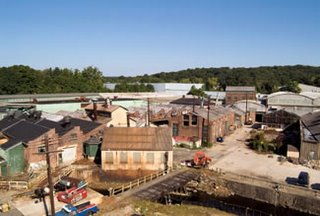 Cleaning up and redeveloping a brownfield site can be daunting for small communities. The Town of Redding overcame this challenge by working with a developer with brownfield experience to manage the cleanup and redevelopment of a closed industrial site into a healthy, convenient, attractive neighborhood.
Over 1,000 people, including citizens of Redding as well as local, regional, state, and federal stakeholders participated in workshops that helped define the cleanup plan, historic preservation guidelines, and master plan for the redevelopment.
Closure of the Gilbert & Bennett wire mill in 1989 left a 55-acre, contaminated, industrial site in Redding’s Georgetown section, the primary commercial zone for this town of 8,400 residents. By 2002, the facility that was once a major source of tax revenue had accrued unpaid taxes of over $1 million. To revitalize the area and protect public health, the town partnered with a developer who not only paid the tax lien in full, but also cleaned up the contamination and is redeveloping the site into a mixed-use neighborhood. This partnership has been good for the town and the developer—each benefits from the new homes, businesses, services, and revenue.
In a week-long public workshop, over 1,000 stakeholders from the town and from regional, state, and federal governments developed the design for the new neighborhood. A key component of the plan is a lively diversity of uses, including 416 homes in a wide variety of styles, 109,000 square feet of shops and restaurants, 113,000 square feet of office space, a performing arts center with a black box theater, and a health facility with a public pool. To honor the mill’s heritage, 15 of the site’s historic buildings will be rehabilitated, and 21 new buildings will be designed in a historically sensitive manner.
Pedestrian-friendly design features such as trails, wide sidewalks, short blocks, and narrow streets encourage people to walk around the neighborhood. To give residents more transportation choices, the developer is building a commuter train station that will provide easy access to Manhattan.
The Gilbert & Bennett wire mill redevelopment is a model for complex reuse projects. The strong public-private partnership invited community input in the design process, facilitated the remediation plan, and expedited adoption of the master plan.
When the neighborhood is complete, the Town of Redding expects that it will create over 1,700 permanent jobs and provide the town with $4.7 million in new, annual property tax revenues.
Is it any wonder that Redding, CT, was rated Connecticut's number one small town?
 Every community has one -- at the very least. A "brownfield." An abandoned movie theater, once the art-deco pride of town, now a crumbling relic serving as cover for drug deals and muggings; A chain of vacant stores, part of a once bustling "Main Street" that, over the years, has yielded both appeal and shoppers to the "big box" stores; that seedy no-tell motel, home to prostitution, violent crime, and the unsavory we keep at bay by putting out of mind; the old concrete plant or scrap metal yard, once integral parts of the local economy, now nothing more than eyesores taking up valuable space in the very heart of community.
The mindset we've kept, at least as long as most of us have lived on this island, is that, well, we simply have to live with the ugly, the outdated, the relics of a time passed that have no place in a modern, suburban setting.
Ah, but what to do?
Perhaps the best way to take the lead on the redevelopment front is, as the old adage goes, by example.
Here's one we happened upon, courtesy of U.S. Environmental Protection Agency, no less. We reprint the story of one suburban town's successful efforts to reclaim, rebuild, and reinvent it's "Downtown."
Gilbert & Bennett Wire Mill Redevelopment, Town of Redding
Redding, Connecticut
 Cleaning up and redeveloping a brownfield site can be daunting for small communities. The Town of Redding overcame this challenge by working with a developer with brownfield experience to manage the cleanup and redevelopment of a closed industrial site into a healthy, convenient, attractive neighborhood.
Over 1,000 people, including citizens of Redding as well as local, regional, state, and federal stakeholders participated in workshops that helped define the cleanup plan, historic preservation guidelines, and master plan for the redevelopment.
Closure of the Gilbert & Bennett wire mill in 1989 left a 55-acre, contaminated, industrial site in Redding’s Georgetown section, the primary commercial zone for this town of 8,400 residents. By 2002, the facility that was once a major source of tax revenue had accrued unpaid taxes of over $1 million. To revitalize the area and protect public health, the town partnered with a developer who not only paid the tax lien in full, but also cleaned up the contamination and is redeveloping the site into a mixed-use neighborhood. This partnership has been good for the town and the developer—each benefits from the new homes, businesses, services, and revenue.
In a week-long public workshop, over 1,000 stakeholders from the town and from regional, state, and federal governments developed the design for the new neighborhood. A key component of the plan is a lively diversity of uses, including 416 homes in a wide variety of styles, 109,000 square feet of shops and restaurants, 113,000 square feet of office space, a performing arts center with a black box theater, and a health facility with a public pool. To honor the mill’s heritage, 15 of the site’s historic buildings will be rehabilitated, and 21 new buildings will be designed in a historically sensitive manner.
Pedestrian-friendly design features such as trails, wide sidewalks, short blocks, and narrow streets encourage people to walk around the neighborhood. To give residents more transportation choices, the developer is building a commuter train station that will provide easy access to Manhattan.
The Gilbert & Bennett wire mill redevelopment is a model for complex reuse projects. The strong public-private partnership invited community input in the design process, facilitated the remediation plan, and expedited adoption of the master plan.
When the neighborhood is complete, the Town of Redding expects that it will create over 1,700 permanent jobs and provide the town with $4.7 million in new, annual property tax revenues.
Is it any wonder that Redding, CT, was rated Connecticut's number one small town?
UPDATE FROM REDDING, CT: Redding Brownfield Redevelopment Project Receives $600,000 Grant from State to Help With Contaminant Removal
- - -
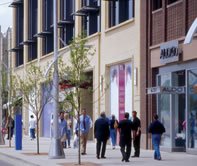 It is hard to believe that the brownfield depicted in the lead photo above (a declining shopping mall in Lakewood, CO) could be literally transformed into a development that will include vibrant retail space (as shown in the rendering at left), 1,300 new homes, including town homes, loft apartments, and live-work units, and open, "green" spaces for recreational use.
Yet, this is exactly what is happening in towns, villages and hamlets across America.
Why don't we see more of this kind of redevelopment on our Long Island? Why do we address today's tribulations and tomorrow's concerns with yesterday's tunnel vision? Good questions.
Perhaps the answers lie in a populace mired in old ways of thinking; in the fact that our local governments continue to "plan," "zone," and build much as they did a century ago; in our own inertia, a failure to get moving in the right direction borne out of the fear that it will be the wrong direction.
Other than the waters of the Long Island Sound, what is it that separates, say, a Town of Redding from a Town of Hempstead -- the intuitively progressive from the hopelessly regressive?
Is it that because we're "bigger" we can't be "better?" The answer to that one is as simple as the troubles faced by our dysfunctional "Downtowns" and aging "Main Streets." It's not just a matter of money -- the funding is out there for those ready to pull the brass ring. [Besides, if we wait until "tomorrow," what we truly must do today will only cost us twice as much.] It certainly is not a lack of ideas. [Take half the number of e-mails we get at The Community Alliance and you could still build a monument taller by far than the lighthouse at Montauk Point.]
Perhaps it all boils down to that basic want of will as is necessary to find the way.
Can we turn Long Island's brownfields into the greener pastures now being sewn in places like Redding, CT and Lakewood, CO? Of course we can. That is, if we really want to!
- - -
 It is hard to believe that the brownfield depicted in the lead photo above (a declining shopping mall in Lakewood, CO) could be literally transformed into a development that will include vibrant retail space (as shown in the rendering at left), 1,300 new homes, including town homes, loft apartments, and live-work units, and open, "green" spaces for recreational use.
Yet, this is exactly what is happening in towns, villages and hamlets across America.
Why don't we see more of this kind of redevelopment on our Long Island? Why do we address today's tribulations and tomorrow's concerns with yesterday's tunnel vision? Good questions.
Perhaps the answers lie in a populace mired in old ways of thinking; in the fact that our local governments continue to "plan," "zone," and build much as they did a century ago; in our own inertia, a failure to get moving in the right direction borne out of the fear that it will be the wrong direction.
Other than the waters of the Long Island Sound, what is it that separates, say, a Town of Redding from a Town of Hempstead -- the intuitively progressive from the hopelessly regressive?
Is it that because we're "bigger" we can't be "better?" The answer to that one is as simple as the troubles faced by our dysfunctional "Downtowns" and aging "Main Streets." It's not just a matter of money -- the funding is out there for those ready to pull the brass ring. [Besides, if we wait until "tomorrow," what we truly must do today will only cost us twice as much.] It certainly is not a lack of ideas. [Take half the number of e-mails we get at The Community Alliance and you could still build a monument taller by far than the lighthouse at Montauk Point.]
Perhaps it all boils down to that basic want of will as is necessary to find the way.
Can we turn Long Island's brownfields into the greener pastures now being sewn in places like Redding, CT and Lakewood, CO? Of course we can. That is, if we really want to!
Wednesday, March 07, 2007
Planning For Long Island's Future
Does Long Island's New Regional Planner Actually Have A Plan?
We always laughed -- usually out loud -- when anyone used the word "planning" in the same sentence as "Long Island."
A generation or two of haphazard development, unbridled growth, and reckless, "wink-n-nod" zoning has left much of our Island -- particularly the business districts (or what's left of them) -- looking like Berlin after the blitz.
Transportation, where it exists at all, is a mess. Congestion is everywhere. Walkability, and the very idea of "neighborhood," has gone out the door, with livability following close behind.
Look around most Long Island communities and you'd be hard pressed to say that anyone had a "plan" -- let alone a vision that evolved into a workable plan -- when projects lept from drawing board to street corner.
Both counties on Long Island have Planning Commissions, and the Towns all have offices that operate under the blatant misnomer of Planning & Economic Development, but truth is, there hasn't been any real master plan -- a viable, sustainable plan -- for our Island since developers first put asphalt to potato field in the late 1940s.
And so, when Long Island's new Planning Czar, Michael White, formally takes office this week, we cannot help but wonder whether, in fact, he has a plan, will find a plan, or will at least call upon others, those who would like to see some plans, to get together to make plans for Long Island's future.
White told Newsday his immediate plans are to call for an island-wide planning summit, with the hope of getting all interested parties on the same page -- or at least in the same book.
Good luck with that, Mike.
We've seen summits come and go (mostly go) on Long Island -- property tax summits, school finance summits, even community alliance summits -- with way too little in the way of tangible result to show for it.
Still, we do need plans, and the planners to plan them, and perhaps Mr. White will be the catalyst we've longed for -- a man who can, as he put it, "engage all levels."
We wish Michael White the best of luck in this new endeavor, and stand ready and willing to join him for a summit and at the drafting table.
Call us, Mike. Let's make plans!
- - -
New planning chief surveys LI's future
By Rick Brand
When the Long Island Regional Planning Board was formed in 1965, its young director Lee Koppelman was charged with bringing order to a roaring suburban boom, fueled by the city's post-war generation looking for a backyard paradise.
Tomorrow, Michael White will officially step in as Koppelman's successor and begin trying to unknot vexing problems that face the region's aging suburbs in the new millennium.Those problems are daunting.
Housing has become so expensive that offspring of baby boomers cannot afford to live anywhere but their parents' basements, forcing an exodus off the Island. Add to that surcharges that nearly equal the bill for electricity, high property taxes and exotic mortgage financing that eats up more wages than it should. Throw in traffic snarls that produce smog, delay and agita because there is little mass transit. And if that wasn't enough, there still is the need to preserve land and protect the water supply, while attracting new business to avoid a brain drain of those educated in local schools.
"We know the problems, and what has caused the problems," said White, 51, an environmental lawyer. "What we need is to focus on the end line of the solutions and the plans for implementing those solutions rather than just draw plans that sit on a shelf."
White studiously avoided mentioning Koppelman, who led the region's planning efforts for the past four decades until he resigned under pressure last year amid questions about the board's finances and its payments to former Suffolk Legis. Wayne Prospect, who has been convicted of bribe-taking. During his time, Koppelman successfully pressed for a county road network, sewers, open space and farmland purchases, as well as studies to protect the region's groundwater. But in other areas, particularly housing, he was largely ignored.
"We just can't rely on doing things from the top down," White said. "We have to engage all levels and that's what has been lacking. We have to make the towns and villages an integral part of the planning process. We don't have all the answers we need for good collaborative solutions."
Toward that end, White said he expects the agency will call an Islandwide planning summit to get all levels of government and interest groups working together.
Although declining to take a stand on most regional issues, White spoke out on a proposal to build an offshore liquid natural gas terminal in Long Island Sound. "No one has made a convincing argument that Long Island needs Broadwater," he said. White, to underline his understanding of his role, emphasized he works for his board and intends to spend as much time in Nassau as in Suffolk in his $140,000-a-year job.
While a long-time resident of Centerport in Suffolk, White said he has worked in Nassau for the past 17 years.White said he also is sensitive to concerns about his wife Judy, a public relations consultant who represents developer Edward Blumenfeld, who is planning the Tanger Outlet Mall in Deer Park. White said if a potential for conflict arises he will disclose and follow proper procedures. He also said he immediately will renew efforts that stalled in Nassau last year to update and expand the board into a planning council. He said the new board will have an annual budget of at least $300,000, a 50 percent increase from current levels, and hopes to raise money from outside as well. He would also like to see three or four employees working directly for the board, rather than use borrowed county staff.
Where planners 40 years ago dealt with an undeveloped landscape, untrusting governments and developers always at odds with civic groups, White says the playing field has changed.
"I don't think the battle lines are absolute any longer," he said. "There's a clear recognition all sides have common interests to resolve issues facing us."
Copyright 2007 Newsday Inc.
Monday, October 05, 2009
A Cool Reception For "Cool Downtowns"?
90/10 Solution Evinces Mixed Reviews
They came. They listened. They pondered the future of Nassau County. And they wondered, amidst the lofty proposals and the enduring rhetoric, when will America's first suburb truly witness a rebirth?
Seems to us that this vision of New Suburbia, this ideal of Cool Downtowns, is caught up somplace between "make it happen" and "let it happen".
And then there's "don't let it happen", as in Hempstead Town -- where the answer to "When?" is "Never." Where planning is anathema, and zoning is by exception, rather than rule. Where "smart growth" and the revitalization of "Main Street" (other than by Victorian-style street lamp), are the new drugs, and the Town Supervisor's credo is, "Just say no."
Rarely, if ever, in places like Hempstead Town, does it "happen," even when residents go to great lengths to make it happen. [Do the Argo in Elmont, the Courtesy in West Hempstead, and the Lighthouse Project in Uniondale ring any bells?]
Franky, Nassau County residents can no longer afford to say "no," to stand pat, or to simply "let it happen."
We, as a community, as a determined citizenry, and yes, as taxpayers, dearly in need of a revitalized Nassau as cornerstone of property tax relief, must say "yes," embracing not only the re-imagining and re-engineering of that 10% of our county's landscape -- the blighted, the abandoned, the declining, and the decayed -- but also re-thinking, in a bold, new way, how we live our lives in that other 90%.
Nassau County has a new Master Plan, unlike any such plan that has come before it.
We need to not only scope it out, discuss its merits (and its shortcomings), and debate the pros and cons. That's a given.
We need to embrace the very essence of what this plan entails. A life-giving breath to a suburban community too long on life support, being sustained not by innovative design and thoughful implementation of quintessential ideas, but by our hard-earned tax dollars (as in, good money thrown after bad).
And we need to give a hard, swift kick to the shin -- or higher -- of those powers-that-be (namely, the Zoning Board of the Town of Hempstead and the Town Supervisor, whose "yea" or "nay" (mostly, "nay") is the difference between that new suburbia, and a vast suburban wasteland, over whose plains roll not the progress of a vibrant and enticing new century, but tumbleweeds, over the brownfields, into oblivion.
- - -
From The New York Times:
In the Region Long Island
Retrofitting for a ‘New Suburbia’
By MARCELLE S. FISCHLER
NINETY percent of Nassau County “needs to remain untouched,” Thomas R. Suozzi, the county executive, kept reiterating as he espoused his vision for a “new suburbia.” He extolled the virtues of single-family homes, the North Shore waterfront and the South Shore ocean beaches, the parks and the open spaces — seeing them all as elements that need not change.
But then he got to the topic of the county’s other 10 percent — and it, he asserted, “needs to be completely reimagined, completely re-envisioned.”
To that end, at back-to-back conferences late in September, Mr. Suozzi unveiled a master plan, the “90/10 solution,” cajoling community leaders, developers, environmentalists and change-phobic residents to join a coalition to fix things that need fixing — while retaining the backyards and ball fields that made one of the nation’s first suburbs a desirable place to call home.
The forums took place on consecutive days — the first in Jericho on “Cutting Through the Red Tape: Building on Long Island Today,” the second at the Nassau Veterans Memorial Coliseum, site of the Lighthouse, one of four major projects that Mr. Suozzi is promoting in his retrofitting agenda.
“The public is afraid of anything new, because they are afraid that next development is going to be the last vestige of suburbia that they love,” he declared, even as he detailed a vision of a more enticing — and urban — suburbia, in the form of 18 “cool” new downtowns in places like Island Park and Port Washington. There would be multistory housing near commuter rail stations, he said; there would be restaurants, shops and entertainment.
The goals achieved through these changes, according to Mr. Suozzi, are an expanded county tax base; a halt to the exodus of young people; a cap on crippling traffic congestion; and help for poorer areas.
He also urged his listeners to forge ahead on several projects now being weighed by various communities. Chief among them is the $3.74 billion Lighthouse suburban town center, which is under the scrutiny of Hempstead’s zoning board. (On Thursday, Mr. Suozzi announced a ground lease that would keep the Islanders hockey team at the coliseum through July 2030, subject to county and town approval.)
Others involve the redevelopment of Belmont Park and adjacent parts of Elmont; the transformation of the Glen Cove waterfront with housing, shops and a hotel; and reuse of 105 acres on the Grumman Aerospace plot in Bethpage as a high-tech business incubator.
Among the big concerns he cited was the flight of younger residents. “They want to be where it is fun, where it is exciting, where they can meet other young people,” Mr. Suozzi said. With couples marrying later, and relatively few starting families in their 20s, the suburbs have begun to seem both expensive and dull.
Affordability is also an issue, and the dearth of rentals on Long Island is a factor in that. “It’s not affordable in Brooklyn or Manhattan either,” he said; but, helped along by those areas’ vigorous rental markets, “kids are moving to Manhattan and Brooklyn all the time.”
In Nassau and Suffolk, rentals make up 17 percent of available housing; by contrast, in Westchester County they represent 37 percent.
Throughout the two days, Mr. Suozzi’s message remained consistent — even as the reactions it got were decidedly mixed.
Officials like John Cameron, the chairman of the Long Island Regional Planning Council, lent him their support. Declaring that the Island was “at a crossroads,” Mr. Cameron asserted, “either we will deal with our issues and challenges or it’s game over,” adding, the “no-action alternative will prove that we are not sustainable.”
Residents and other individual participants, however, had concerns. One was voiced by Emarinsie Funderbird, a Roosevelt business owner, who said Mr. Suozzi’s plans would bypass destitute communities like hers, even though they are beset with “all the ills they need to change,” like an abundance of foreclosures, and single-family homes occupied by five to six families. “All efforts will be on the 10 percent” represented by the new projects that the county executive is promoting, she predicted.
James Ruzicka, the mayor of Island Park, who also attended, received applause for asking the county to add his village to the potential downtown list, and made the point that “we could be cooler” right now. Specifically, he was hoping for help in beefing up a two-block area near the train station. “We could use a fix-up and get more business into town,” he said.
Mark Lesko, the Brookhaven town supervisor, said that on the issue of “smart downtowns,” Nassau and Suffolk Counties were in sync. Feeling the lack of town centers, he cited the daunting aspects of creating those “nodes” in places like Ronkonkoma, Port Jefferson and Bellport.
Muzzio Tallini, a developer who had sought to build a 20,000-square-foot mixed-use project with 10 duplexes above retail shops in Elmont, but had his proposal rejected by Hempstead, bemoaned official resistance to change. “Getting anything done on Long Island is very difficult,” he said. “How can we get anything started if this government says no to us all the time?”
For his part Eric Alexander, the executive director of Vision Long Island, a “smart growth” group, took a practical, distanced stance to the entire issue. “Downtowns would regenerate themselves” and “the island will transform over the next 10 years whether we have big mega-projects or not,” he insisted. “The demographics will drive it.”
With residents struggling to maintain costly oversized homes and feeling isolated on cul-de-sacs, demand is already pushing developers to create smaller housing units near train stations, Mr. Alexander said. “That’s clear from applications we see from developers.”
Tuesday, May 16, 2006
The Best Laid Plans
End Of An Era At Long Island Regional Planning Board
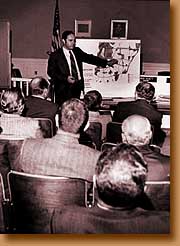 After some forty years at the helm of a ship that more often listed while adrift in a sea of bureaucratic mayhem than it smoothly sailed the charted course, Lee Koppelman, Executive Director of the sometimes troubled Long Island Regional Planning Board, has retired.
New York, including much of Long Island, had it's Master Builder in Robert Moses, while Long Island uniquely held claim to it's Master Planner, Lee Koppelman. Both had their share of critics and detractors, as well as their hard-core supporters. Both were men of grand vision, whose foresight, in the case of Moses, sometimes failed to mesh with -- or so much as take into consideration -- the realities of an evolving community, and, in the case of Koppelman, regularly failed to win the embrace of entrenched political operatives.
Stymied by the stranglehold of town zoning boards and small-minded technocrats, and holding little if any sway over either, the Long Island Regional Planning Board, along with many of Professor Koppelman's best laid plans, floundered.
There were some successes en route, such as the creation of the Pine Barrens preserve. In Suffolk, Koppelman championed the preservation of open space. In Nassau County, his proposals, including pleas to build affordable housing and hopes of developing a light rail system, were mostly ignored.
Failures, and there were a few, including the haphazard development of the Route 110 corridor, were largely the product of institutional malaise and governmental arrogance rather than Dr. Koppelman's own perceived shortcomings.
Unlike Moses, who wielded great power and commanded the ability to raise large sums of money for his pet projects, all Lee Koppelman could do was to offer what he considered as prudent advice, too much of it, unfortunately, falling upon deaf ears at both county and local levels.
Among, Dr. Koppelman's ideas, first advanced during the 1960s, and incorporated into the 1970 "Comprehensive Plan for 1985" were:
Transportation: Expand the highway network, build two bridges over Long Island Sound, revamp the Long Island Rail Road and establish an integrated bicounty bus system.
Housing: Build 400,000 new units by 1985, including 128,500 rental apartments for residents under 25 and over 65.
Land use: Cluster construction to preserve open land, acquire parkland, limit development in North Shore estate areas and on the East End, and preserve at least 30,000 acres of farmland.
Taxes: Create countywide taxing districts to pay for schools and impose county sales taxes to prevent an anticipated doubling of the average Long Island homeowner's tax bill in 15 years to pay for increased public services.
They weren't listening then, and, lip service to "smart growth," "downtown revitalization" and school and special district "consolidation" aside, for the most part, those who rule the roost over regional and community-based plans are not listening still.
Today, there is a call, chiefly by the Island's two County Executives, to strengthen the Regional Planning Board. James Larocca, the Board's Chairman, and the newly appointed Board members, have the opportunity to seize upon the vision of Messrs. Levy and Suozzi and search out a successor to Dr. Koppelman who would boldly go where no planner dared -- or was permitted -- to go before.
Long Island stands at the crossroads in it's course as America's first suburb. Property taxes spiraling ever-upward. Housing out of reach to all but the extremely wealthy. The commercial base fleeing. Traffic at a standstill. The water below is tainted. The air above, stagnant. From taxes to transportation, there appears to be little in the way of a plan, master or otherwise.
Lee Koppelman wanted Long Island to think and act like the region it is. He would have delighted as well, we believe, had we acted more locally on the community front to create neighborhoods that felt more like, well, neighborhoods, rather than the strip malls and sprawling brownfields that have all but destroyed that sense of community the neighborhood was intended to promote.
Sometimes, neighborhoods just happen. The best of them develop and thrive naturally, without the intervention of either master planners or master builders. At other times, community needs the boost that only a regional plan -- one that takes into account the vitality of the neighborhood -- can provide.
Now is the time for the Long Island Regional Planning Board to take the helm again and, with vision, leadership, and a dash of tenacity, to ply Long Island's waters with a full head of steam. It is also time for Long Island's 2 counties, 13 towns, 2 cities, and 93 villages (and we haven't begun to include in the count Long Island's 126 school disticts and 700 some-odd "special" districts) to board the ship and begin to row together in the same direction at the same time.
As Lee Koppelman said some forty years ago, "We can't afford to wait!"
 After some forty years at the helm of a ship that more often listed while adrift in a sea of bureaucratic mayhem than it smoothly sailed the charted course, Lee Koppelman, Executive Director of the sometimes troubled Long Island Regional Planning Board, has retired.
New York, including much of Long Island, had it's Master Builder in Robert Moses, while Long Island uniquely held claim to it's Master Planner, Lee Koppelman. Both had their share of critics and detractors, as well as their hard-core supporters. Both were men of grand vision, whose foresight, in the case of Moses, sometimes failed to mesh with -- or so much as take into consideration -- the realities of an evolving community, and, in the case of Koppelman, regularly failed to win the embrace of entrenched political operatives.
Stymied by the stranglehold of town zoning boards and small-minded technocrats, and holding little if any sway over either, the Long Island Regional Planning Board, along with many of Professor Koppelman's best laid plans, floundered.
There were some successes en route, such as the creation of the Pine Barrens preserve. In Suffolk, Koppelman championed the preservation of open space. In Nassau County, his proposals, including pleas to build affordable housing and hopes of developing a light rail system, were mostly ignored.
Failures, and there were a few, including the haphazard development of the Route 110 corridor, were largely the product of institutional malaise and governmental arrogance rather than Dr. Koppelman's own perceived shortcomings.
Unlike Moses, who wielded great power and commanded the ability to raise large sums of money for his pet projects, all Lee Koppelman could do was to offer what he considered as prudent advice, too much of it, unfortunately, falling upon deaf ears at both county and local levels.
Among, Dr. Koppelman's ideas, first advanced during the 1960s, and incorporated into the 1970 "Comprehensive Plan for 1985" were:
Transportation: Expand the highway network, build two bridges over Long Island Sound, revamp the Long Island Rail Road and establish an integrated bicounty bus system.
Housing: Build 400,000 new units by 1985, including 128,500 rental apartments for residents under 25 and over 65.
Land use: Cluster construction to preserve open land, acquire parkland, limit development in North Shore estate areas and on the East End, and preserve at least 30,000 acres of farmland.
Taxes: Create countywide taxing districts to pay for schools and impose county sales taxes to prevent an anticipated doubling of the average Long Island homeowner's tax bill in 15 years to pay for increased public services.
They weren't listening then, and, lip service to "smart growth," "downtown revitalization" and school and special district "consolidation" aside, for the most part, those who rule the roost over regional and community-based plans are not listening still.
Today, there is a call, chiefly by the Island's two County Executives, to strengthen the Regional Planning Board. James Larocca, the Board's Chairman, and the newly appointed Board members, have the opportunity to seize upon the vision of Messrs. Levy and Suozzi and search out a successor to Dr. Koppelman who would boldly go where no planner dared -- or was permitted -- to go before.
Long Island stands at the crossroads in it's course as America's first suburb. Property taxes spiraling ever-upward. Housing out of reach to all but the extremely wealthy. The commercial base fleeing. Traffic at a standstill. The water below is tainted. The air above, stagnant. From taxes to transportation, there appears to be little in the way of a plan, master or otherwise.
Lee Koppelman wanted Long Island to think and act like the region it is. He would have delighted as well, we believe, had we acted more locally on the community front to create neighborhoods that felt more like, well, neighborhoods, rather than the strip malls and sprawling brownfields that have all but destroyed that sense of community the neighborhood was intended to promote.
Sometimes, neighborhoods just happen. The best of them develop and thrive naturally, without the intervention of either master planners or master builders. At other times, community needs the boost that only a regional plan -- one that takes into account the vitality of the neighborhood -- can provide.
Now is the time for the Long Island Regional Planning Board to take the helm again and, with vision, leadership, and a dash of tenacity, to ply Long Island's waters with a full head of steam. It is also time for Long Island's 2 counties, 13 towns, 2 cities, and 93 villages (and we haven't begun to include in the count Long Island's 126 school disticts and 700 some-odd "special" districts) to board the ship and begin to row together in the same direction at the same time.
As Lee Koppelman said some forty years ago, "We can't afford to wait!"
Thursday, October 29, 2009
It's Not Only About The Islanders
It's About Saving Nassau County From The Dust Bowl
If the Lighthouse Project was only about keeping the hapless, and nearly winless, Islanders at the Nassau Coliseum (home to the International Great Beer Expo), we would almost certainly be inclined to say -- no, to beg -- 'take 'em away!"
But this planned redevelopment of what is now an asphalt wasteland --reminiscent of the great plains during the 1930s, sans the tumbleweed and the dust storms -- is about so much more than keeping a hockey team (is that what the Islanders are?) on Long Island.
The Lighthouse Project would not only be a job creator, an economic booster, and a civic center for a county whose hallmarks, at least over the past quarter century, have been sprawl, brownfields, and suburban blight, it would be a boom to an aging island population, trying to keep Generation Next close to home, and beckon those next door to take a second look.
"It would be too big, too massive, too tall?"
Well, what does it say for a county whose tallest structure, by far, is the Covanta incinerator chimney in Westbury?
How do we stop the brain drain and attract a young, vital workforce, when redevelopment is defined as a white picket fence circa 1952?
Where is the vision that will take America's first suburb from the current nightmare scenario, where flight seems right, to the full potential of the suburban dream?
Are we lacking visionaries? Leadership? The will to find a way?
We have the visionaries, apparently. Folks who see the big picture and understand that a thriving suburbia is a great deal more than Levitt capes surrounded by vacant strip malls.
Is it the lack of leaders who can take an island with a 1950s mindset into the 21st Century?
Well, face it, Kate Murray is no Moses, and the Town of Hempstead, whose Zoning Board ostensibly holds the key to any changes in the infrastructure of the greater part of Nassau County, is much better at carving out exceptions to the Building Code than in incorporating Smart Growth principles into the Town's agenda. [We'd say, the Town's Master Plan, but clearly, beyond Blight Studies and faulty "Urban" renewal schemes (scams?), there really is no Master plan!]
As much as we chided Katuria D'Amato (Al's wife) as a patronage hack in her early days on the Town ZBA, she's proven herself the brightest member of the Board, shaking her head when one or more of her fellow Board members chimes in with a foolish comment or altogether dumb question, and rolling her eyes whenever the Chairman opens his mouth or counsel needs testimony repeated because he simply cannot hear. [As opposed to the rest of our Town officials, who can hear, but simply choose not to listen!]
Actually, Katuria D'Amato (congrats on the new baby, by the way) gets it. Too bad no one else at the Town of Hempstead seems to.
The will to find a way? Maybe they're all stuck in traffic on the Merchant's Concourse. Or it could be that the vision thing we so often speak of is shortsighted rather than long term.
Imagine if planners of yore (not mine, but yore), did not have the vision to turn a filthy, downtrodden slum into what would become Lincoln Center? An overflowing great ash heap into Flushing Meadow Park (and two World Fairs)? Or a flat, nearly barren plain, twenty miles from the City, into America's first suburban community?
Before us, right here in the Town of Hempstead, Nassau County, Long Island, New York -- that place we so humbly call home -- lies the great opportuninty not only to reimagine the future of suburbia, but to reinvent it, and to make it work again, for ourselves, our children, and generations of Long Islanders yet to come.
We are, each of us, pioneers of a new sort, in a new and significant era, on these Hempstead Plains.
We are, each in his own way, Islanders!
- - -
Cue the tumbleweeds. . .
Monday, May 23, 2011
Build Something -- Anything -- And They Will Come! Maybe.
From Blighthouse To Lighthouse To....
In a land where the vertically challenged rule the roost (or at least the Zoning Boards), where density is more or less a four-letter word, and Smart Growth, as it is typically defined, is something of an oxymoron, development -- and, where brownfields abound, redevelopment -- has become somewhat of a challenge.
With NIMBYists on every corner, mega-developers vying to trade open space for the next big thing, and zoning boards sitting as planning boards, doing neither with any alacrity or clarity, the road to rejuvenation, from downtown to the Hub, has been blocked with more obstacles than Carter had little pills.
Standing at the crossroads here in Nassau County, straddling the intersection of No Place and No Where (particularly where the street signs are missing, obliterated or hidden behind overgrown vegetation), residents are now faced with a referendum on the very future of Long Island. And while the question to be posed concerns whether we issue bonds -- some $400 million worth -- to build a new Coliseum, the real referendum ponders a more long term fate. Do we stand still, mired in yesteryear, leaving our island to be overrun by tumbleweeds, or do we move forward, laying the foundation for a viable, livable, smartly designed Long Island.
Frankly, standing still is not an option. To do nothing is to entomb Long Island in its own decaying infrastructure, assuring that the surveyed, who have been leaving our island in droves for decades (by the poll numbers, there should be no one left here but the squirrels), will yet again affirm that this is no place to live, to work, to raise families.
To build recklessly, on the other hand, by piecemeal, while increasing the tax burden to homeowners and business owners alike, is certainly not forward-thinking.
So, what to do?
Does a spanking new arena for the Islanders to have ice time -- or, for that matter, a minor league ballpark at Mitchel Field -- really change the landscape, opening the door not only to job growth but to a sustainable suburbia?
Sure, the Isles will have a new place to play, but, given the dirth of affordable housing, particularly for Generation Next, the diminishing job opportunities, the skyrocketing property taxes, and the ever-eroding tax base, where will their fans live?
What of the region's lack of transportation alternatives? Are we talking walkable here? You can get there from here, but only by car, through congested, pothole marked streets, with nary a Long Island Bus on the horizon. Light Rail, anyone?
Do a new arena, a minor leage ballfield, and, should the State, Feds and Indian Chiefs allow, a casino at Belmont park, truly change the dynamics of Long Island?
And what about Elmont's Argo, Baldwin's Grand Avenue and the many Main Streets, byways and downtrodden downtowns that dot Long Island? Will this be a "turn-the-corner" moment for communities across the island, or merely a pause in the disaster that has been the hallmark of planning, zoning and development in the region since the LI Regional Planning Board inked its very first Master Plan?
Panacea? Surely not. A fresh start for America's oldest suburb? Indeed!
We need to start down that road to revitalization sometime and somewhere. The "sometime" is now, not in 2035. The "somewhere" is the Nassau Hub, as cornerstone for rebuilding the spokes that are Long Island's neighborhoods.
Yes, we've managed to turn a $3.8 billion, privately financed, comprehensive plan to reinvent suburbia at the hub (the Lighthouse Project), into a $400 million, taxpayer financed, scantily detailed proposal to build a couple of stadium -- stadia?
Still, we need to get out of the starting gate.
Granted, there remain many more questions than there are answers. About revenues. About plans for the 77 acres surrounding the Coliseum. About who will develop what, when, and exactly where.
How do we preserve the suburban character of our Long Island while necessarily taking this region out of the 1950s and into the 21st century?
Hopefully, come August 1 (the date set for the referendum vote), we will be all the more knowledgeable and informed on the prospects of the hub as Ground Zero for the island's, if not the Islanders', resurrection. Then too, maybe we will have a clearer picture of what the plans are -- assuming there are any plans -- beyond the arena and the ballpark.
It's not simply about a new arena. On the line is whether Long Island's "Asphalt Wasteland" (we dare not conjure up visions of a paved over paradise) is transformed into a centerpiece of suburban renewal, sparking that long-awaited, much needed renaissance for points north, south, east and west.
"Build it and they will come?" That all depends upon the "it" to be built, and the "they" we hope to attract. That said, the imperative is clear. Have a plan. Not a notion. Not a sound byte. Not a shortsighted fix. A viable, doable, sustainable plan. Then, actually build something -- anything (well, almost anything) -- and let's begin to move Long Island forward together!
- - -
Thoughts on the proposals for the Nassau Hub, a casino at Belmont, creating a truly sustainable Long Island? Post your Comments Below. Write us at TheCommunityAlliance@yahoo.com. Follow us on Twitter at www.twitter.com/CommunityAlli.
Be a part of Long Island's tomorrows!
Thursday, December 15, 2005
Elmont Elevating
A Case Study In "Smart Growth" And Suburban Revitalization: Town Meeting Offers Elmont Residents New Ideas/Approach/Vision
More than 80 enthusiastic “stakeholders” wanted to know, “What’s the next step?” in the community visioning process for a better Elmont at the Town Meeting sponsored by Elmont Quality of Life (EQL) Committee November 29th. They were ready to make Elmont better.
Residents, civic and business leaders, and representatives of elected officials listened to and viewed a presentation by Sarah Lansdale, Executive Director of Sustainable Long Island, and Sol Marie Alfonso Jones, SLI's Director of Programs, on the partnership that can be created to work effectively to empower Elmont residents to work for and implement plans for “dream community.”
“Think about Elmont 10-20 years down the road,” challenged Alfonso Jones. “What would your dream community look like? How can we plan for smart growth?”
Last February, Ali Mirza, a local businessman and recent candidate for Nassau County Legislature, had invited Sustainable Long Island (SLI) to a meeting in Elmont, and interest in what they have accomplished in other communities mushroomed and they were invited to other meetings to talk about partnering to help grow economic diversity, environ-mental health and social equity in Elmont.
SLI facilitates by networking and reaching out to communities, encouraging municipal involvement, and utilizing its resources to help vision, develop and implement plans to create better communities. EQL became the contact in Elmont.
A power-point presentation highlighted SLI’s work in Huntington Station, “The Gerard Street Partnership,” showing total community involvement in all stages of visioning, planning and implementation. The stakeholders were engaged at every level, from identifying needs, developing a plan, then going on a walk through of the town to see things from other perspectives.
The process, explained Alfonso Jones, can take 6-12 months to develop a plan to address Elmont’s needs, to work toward making the right decisions for smart growth.
EQL member Sandra Smith summed up the discussions that have been taking place with SLI, saying that the consensus was that Hempstead Turnpike should be the starting point. The results of the survey printed in the Elmont Herald, concurred that cleaning up, beautifying and encouraging business that would enhance the appearance of Hempstead Turnpike were a priority. The audience agreed.
More community members must become involved in the visioning process so that everyone (all residents and businesses are stakeholders) is heard. Once the visioning is complete, the information is synthesized, and professionals will create images for the communitys review. Once the plan is developed, it is unveiled to the community for further input, presented to the Town Board for adoption, and then implemented.
Lorraine Ferrigno asked how effective can a plan be in the unincorporated hamlets of the Town? How can the Town enact zoning laws, for example, that would only impact Elmont?
When a community develops and embraces a plan and brings it to the Town for support, explained Alfonso Jones, and SLI has been able to secure funding for the proposals, the Town Board adopts and supports the plan. It makes a commitment to the people of Elmont.
As a follow-up, Scott Cushing from Assemblyman Alfano’s office asked, “How do you work with individual property owners to ensure that they will cooperate with the effort?”
Mirza noted that if business owners are part of the process they will understand what type of business the community wants. “Businesses want to make a profit, so businesses we want and need will come.”
SLI has already begun reaching out to our elected officials. Representatives of Congresswoman Carolyn McCarthy’s office, Assemblyman Tom Alfano’s office, and Town Councilman Ed Ambrosino’s office, were in the audience.
Elmont resident Steve McManus suggested that since Belmont Race Track is the first thing people see when they enter Elmont, they should also be involved in this renewal process.
The meeting was over at 9:00 PM, but attendees could be heard discussing ideas and sharing thoughts to make Elmont a better place to live, work and play long after the meeting ended.
SLI will continue to reach out to the community for its input. Residents and business owners need to make a special effort to attend the next meeting to become involved. Civics are also encouraged to contact SLI and invite them to speak to their memberships at future meetings.
Reprinted, with permission, from the Elmont Herald. Roy J. Mezzapelle, publisher.
- - -
Residents interested in learning more about the mission and initiatives of Sustainable Long Island can call 516-873-0230 or send an e-mail to sli@sustainableli.org. The Elmont Quality of Life Committee can be contacted through the Elmont Herald at elmontherald@aol.com.
- - -
Elmont Elevating, as the project has been gratuitously dubbed by The Community Alliance (there being no place to go but up), represents a crucial next step in revitalizing the landscape of America's oldest suburb.
On the westernmost fringe of Nassau County, Elmont, perhaps more than any other community, has felt the pain and witnessed the devastation of urban sprawl. Its once proud and bustling 'Main Streets' have given way to suburban decline, the bright and shiny yielding to the blight and grimy.
It doesn't take a Master Builder (with history as a guide, we may well be better off without one) to understand that you cannot cure the ills of a community by throwing brick pavers or Victorian lamp posts at 'Main Street.' What is needed is a holistic approach, blending affordable housing, retail stores and recreational spaces, creating the liveable, "walkable" communities that today's visionaries call "smart growth." We call it "common sense."
In New Cassel, located in the Town of North Hempstead, a rebirth of a community long in decline is now underway. 20 years in the making, a willing partnership of community, government, and the private sector has amassed not only some $80 million dollars in "seed" money, but the wherewithal to rethink, redesign and replant the suburban setting. [SEE, A 'New' Day Has Begun.]
Residents of Elmont are psyched. Civic leaders are energized, at the ready to move forward. Private developers, no doubt, will be chomping at the bit to bid on new construction projects. Congresswoman Carolyn McCarthy, prominent in securing funding from Washington for New Cassel's work in progress, has already expressed support for the Elmont project, as have State and County officials. Elmont provides the Town of Hempstead, too often the laggard on the redevelopment front, the canvas upon which it, too, can wield the revitalization brush. In reality, holding all the marbles, so to speak, in terms of zoning and development, the Town must be the first to stir the can of paint, and not the last to touch the palette.
In years past, Hempstead Town officials have been big on mouthing the words of revitalization -- and we've seen the artists' renderings of the 'new' Elmont to prove it -- but way short on putting either real money or purposeful action where that mouth is. Town officials must do more than to tacitly comit to Elmont's rebirth, seeing to it that plans finally move from the drafting board to Hempstead Turnpike and Elmont Road.
For those who do not reside in or about the home of the Belmont Stakes, Elmont offers a glimpse -- not unlike the visions visited upon old Mr. Scrooge -- of what our suburban hometowns are likely to look like and ultimately become should we fail to build -- and rebuild -- sustainable communities. We must heed that vision, and move well beyond it, if our suburban lifestyle is to endure and thrive.
Friday, September 18, 2009
Join the 90/10 Coalition Today
Be Part of the Future of Nassau County

“New Suburbia”, County Executive Tom Suozzi’s plan for the future of Nassau County, is ready to be unveiled to the public next week. In order to gauge support for the plan, the 90/10 Coalition was born – a group of individuals, businesses, organizations, elected officials, and others who support the County Executive’s view that future growth in Nassau County should be encouraged in 10% of the County. The rest of the County should continue to preserve and enhance all that is currently good about the County.
Click HERE for a summary of the 90/10 Coalition. Please look over this material and agree to be part of the solution today. Email the County Executive at masterplan@nassaucountyny.gov and say, “I want to be part of the 90/10 Coalition.” Give your name and you will added to the list.
The County Executive will hold his next meeting on the Master Plan on Wednesday, September 23 at 11 a.m. on the lower level of Nassau Coliseum. All are invited to attend; however, seating is limited. Please email (masterplan@nassaucountyny.gov) or call (516.578.5447) and let the 90/10 Coalition know if you will be able to share the morning with the County Executive.
At this meeting, the County Executive will explain the 90/10 Solution and announce the charter members of the 90/10 Coalition -- those people, organizations and businesses that have already told us that they are willing to say, “I support the 90/10 Solution to Nassau’s Future”.
We look forward to seeing you on the 23rd and hope you will join the 90/10 Coalition.
- - -
QUESTION: Rather than keeping 90% and changing 10%, might we consider revising the percentages, particularly for the unincorporated areas of Nassau County, and largely in the Town of Hempstead, where 90% of what residents have -- blight, brownfields, declining downtowns, among other byproducts of neglect -- is prime for future growth?
Friday, November 19, 2010
Long Island 2035?
We Can Hardly Wait!
Actually, we can't wait. Not another generation. Not another decade. Not even another year.
Long Island's economy, infrastructure, mindset of suburbia, all need to come of age now, not some 25 years hence, best laid blueprints of planning councils and "visionaries" (as in the adherents of the "visioning" process, rather than those possessed of any real foresight) notwithstanding.
Long Island 2035 is, in its own words:
The Long Island 2035 Regional Visioning Initiative was funded by the New York Metropolitan Transportation Council (NYMTC) to help achieve a regional public consensus for where the next generation of Long Islanders could live and work, the transportation systems needed to support these settlements, and the institutional actions required to ensure a prosperous, equitable and environmentally sustainable Long Island. The project's findings are being used to help the Long Island Regional Planning Council produce a Long Island 2035 Comprehensive Regional Sustainability Plan.
So, there you have it, in a nutshell. A study to reach a consesus leading to findings to be used in developing a plan. Hummmph! Imagine that. A consensus? On Long Island? Who's kidding whom?
Not just any plan, mind you, but a Comprehensive Regional Sustainability Plan (CRSP), to be promulgated by the Long Island Regional Planning Council. [Lousy acronym. Try, Comprehensive Regional Action Plan. CRAP. There. That's more like it!]
And this would be Plan Number, what, 100, since Long Island's various planning boards have been generating such initiatives -- and shelving them, accordingly -- from back in the day when Levitt first set eyes upon the fertile Hempstead Plain?
Don't misunderstand. We, at The Community Alliance, are all for planning. Just once in a while -- or in a lifetime -- it would be nice to see one of these "comprehensive" (that which, at one time, was called, "Master") plans evolve from "initiative" (as in "initiate," meaning "to begin") to fruition (as in, "implementation").
Visioning Workshops (which, from the photos, appear to be groups of people trying to piece together a giant jigsaw puzzle that somewhat resembles Long Island). A Visioning Workshop Final Report. [How could it be "final" if this is only an "initiative?"] A Visioning Initiative: Principles and Evaluation Benchmarks. [Benchmarks? Like in Iraq?]
Great stuff. On paper.
Years ago, we used to throw money (when we had money) at projects, with the hope that the more we spend, the better the mousetrap -- or Main Street -- we can build. That didn't work out very well.
Nowadays, we throw money to study projects, to talk about (excuse us, "roundtable") the future, to engage in "visioning" (as myopic as it may be), and to generate "findings" via footnoted reports, stylized charts (the more data, the merrier), and high tech PowerPoint presentations.
How's that working out for Long Island?
Yes, we have read the Visioning Initiative Final Report. [Isn't that an oxymoron?] We encourage you to do likewise. [At least take a look at the highlights. (Where's Warner Wolf when you need him?).
Lots of hard work and copious thought going into those 60 pages. Not all that much, however, that is either new or visionary.
By way of history, for instance, the Report opines:
As early as the 1960s, however, the problems associated with growth in these communities, such as increased congestion and fewer unspoiled open spaces, threatened the very qualities that attracted people here in the first place. A succession of village, town, county and regional initiatives emerged to address these challenges, including the creation of the Long Island Regional Planning Board in 1965, one of the first institutions of its kind...
Frankly, not all that much has happened on our Long Island -- save the sprawl, the Levittownization, the brownfielding, and the demise of downtown -- since.
History, indeed, repeats itself, particularly for those who refuse to learn from it!
Much of the hoopla surrounds a central, textbook philosophy -- the stuff new urbanists (suburbanists?) might well embrace (and Jane Jacobs, were she still with us today, might deplore).
Yes, we're all for social and economic equity, a healthy environment, and sustainable communities. [Throw in a farmers' market, or three, and we've got a deal!] Somewhere along that long, green line, however, we need to shift from visioning and talking to actuating and doing. [Our old take on The Home Depot motto, Less Talking. More Doing.]
Bright people among the folks facilitating and participating in the Long Island 2035 initiative. [None, we note with more than passing dismay, from the Town of Hempstead, or so it would appear from the listing in the Final Report, where representation by TOH is conspicuous by its absence.] Surely, there must be a few among these visionaires who realize that, going down this road to 2035 (a road now more traveled and less maintained), we have been this way before, and, those Victorian-style streetlamps along Main Street aside, there hasn't been all that much progress.
Beyond the artists' renderings (almost all of which, in one incarnation or another, we've seen before), or allusions to what has been accomplished in suburbs far from Long Island's shores (not to mention the delusions of getting anything of virtually any scale -- short of a storefront facade -- to appear on our neglected and over-burdened landscape), there must be, one would think, a day of reckoning.
After all, one can't be expected to wait for the revitalization of Elmont, the resurgence of Wyandanch, or the reinvention of the Lighthouse at the Nassau Hub (which will happen, by the way, right after the reinvention of the wheel, for the 100th time) forever, right?
True, that day may come when those of us who have long advocated for change, for redevelopment, for the resuburbanization of Long Island beyond the white picket fences, have passed on to our final reward, whatever that may be. Or, perhaps, when the last of Generation Next has abandoned the land of strip malls, big box stores, unaffordable housing, skyrocketing taxes, and special district fiefdoms that consume every last breath -- and every last dollar -- out of a populace perennially promised the moon and too often delivered manure.
We can, as has become custom in these parts, simply keep putting off Long Island's future to, well, the future.
Or, someone -- anyone, really -- in the back of this Long Island 2035 bus, having sustained about all he/she can of "getting there is half the fun," can pull off the seatbelt, stand up, high tail it to the front, move forward of the yellow line, and shout at those behind the wheel, "ARE WE THERE YET?"
- - -
What are your thoughts about Long Island 2035? Better yet, what about Long Island 2011? What are the initiatives you would like to see taken to improve the quality of life of Long Islanders, rekindle our sagging economy, revive our downtrodden Main Streets, and create a truly sustainable community for the next 25 years and beyond?
Write to The Community Alliance with your thoughts, ideas, suggestions, and comprehensive plans. Guest blogposts for publication would be most welcome. TheCommunityAlliance@yahoo.com.
- - -
Follow The Community Alliance on Twitter at www.twitter.com/CommunityAlli. Better yet, take the lead in your community!
- - -
Tuesday, December 16, 2008
"Smart Growth" Comes To Long Island?
If Its Written In The New York Times, It Must Be True!
"Smart Growth."
A new (or not so new -- it actually dates back to the 1970s), much discussed (even on this blog), highly-touted vision for the development -- and revitalization -- of the urban landscape, as well as suburbia (such that it is), embracing the concepts of walkable downtowns, mixed-use, transit-oriented, high-density, affordable housing, and the reversal of the strip-mall mentality that has given rise to the sprawling of America.
The New York Times featured an article on various projects underway (or soon to be) here on Long Island that, at least in theory, fall under the umbrella of "Smart Growth," this in a region that, but for eastern Suffolk County, is pretty much built out, where growth -- begun with a spurt in the late 1940s -- has been anything but smart, and planning/zoning are as an anathema.
Indeed, notwithstanding the nominal existence of a regional planning and county planning boards -- where Master Plans apparently go to die -- Long Island has, over the past half century, been witness to what can be best categorized as haphazard development, seemingly bereft of any real or functional plans, other than those long ago shelved and collecting dust in the belly of the archives.
Zoning, left mainly to the Towns, has, until recently, been "wink and nod," build it any way you want, building code excepted, creating a hodge podge along "Main Street" that resembles the work of Dr. Frankenstein.
Having been hoisted on their own petard -- viewing the now crumbling and outmoded "downtowns" of Long Island's towns and hamlets for the barren wastelands they have become -- local zoning boards, often sitting as planning boards, are picking up the mantra of "Smart Growth," even where their newly-found enthusiasm for "getting it right" merely masquerades as "smart," and whose "plans," on the heels of "blight studies," are too often paraded down "Main Street" as ersatz "renewal."
Where America's oldest suburb cries out for the creation of a true, workable Master Plan, in draftsmanship and execution, "Smart Growth" appears to be gaining hold but piecemeal, in drips and drabs, and with great reluctance on the part of localities -- namely the townships -- to abandon the arcane and archaic in favor of the future.
A spot build here and a nod to "Smart Growth" there. Very little in the way of a comprehensive plan that would take Long Island, still mired in the 1950s, with a mall and sprawl mentality -- and a decaying infrastructure to show for it -- into the 21st Century.
Well, at least its a start!
- - -
From The New York Times:
‘Smart Growth’ Takes Hold
By MARCELLE S. FISCHLER
CORAM
TYPICALLY, apartments around here aren’t any more than two stories high. But off Middle Country Road, Avalon Charles Pond is a symbol of the future. Its three and a half stories will house 200 one- and two-bedroom luxury rentals.
The new nine-building development represents the new era of so-called smart growth projects on the Island. “Eventually this will be the center of Coram; this will be the hub,” said Connie Kepert, a Brookhaven councilwoman, envisioning more mixed-use development with retailing on the first floor and apartments or offices above. She contrasted this vision of Coram to “traditional downtowns” like Northport and Patchogue.
In years past, developments that put homes, workplaces and services closer together were often viewed askance. But in the last year, a number of higher-density projects have won the approval of civic associations and elected officials.
Some are mixed-use projects; others are transit-oriented developments; many incorporate ecologically sensitive elements. Each with at least 150 units and up to nine stories tall, they reduce hodgepodge sprawl and include more concentrated, vertical residential design, yet aren’t so massive that they loom over their neighbors.
Eric Alexander, executive director of Vision Long Island, a smart-growth planning group, said that in the last year approvals had been issued for a number of developments in addition to Avalon Charles Pond, which is developed by AvalonBay Communities.
Other projects, either new or close to fruition, include: a nine-story condominium in Mineola called the Winston; the Village Center in Islandia, a mixed-use development with hotels, residential condominiums, retailing and office space, and a plaza built on 12.6 vacant acres; a 349-unit transit-oriented apartment project by AvalonBay in Rockville Centre; and two projects by the Atlanta-based Trammel Crow Residential, one in downtown Hempstead Village and the other in West Hempstead.
“It is this oddball combination of higher density and community support” that has until recently been “antithetical to the perception of density and development on the Island,” Mr. Alexander said. “With the right locations and the right types of projects and the right type of process you can get positive results.”
He also pointed out that these alternative approaches to development are “market-viable projects in an economic downturn.”Early this month, after a 15-year effort to shutter the Courtesy Hotel — a locus of crime in West Hempstead — the Nassau County Planning Board took a major step toward that goal by giving Trammel Crow Residential the go-ahead to use the site for the Alexan at West Hempstead Station.
Rosalie Norton, president of the West Hempstead Civic Association, said the 150-unit Alexan would fulfill “a desperate need for housing” and draw more riders to the train, while “not destroying the suburban character of our community.”
She added that the commercial setting of the project — by the West Hempstead station of the Long Island Rail Road but “more than 200 feet away from residential homes” — was “a classic example of the right location.” The rental apartments have “so many positive aspects,” she concluded, that “the fear of the ‘what ifs’ suddenly stops.”
Kathleen P. Murray, the Hempstead town supervisor, said the project was approved once the developer reduced the number of units to 150 from 225 — which had been “very significantly over what was allowable.” An extra acre of adjacent land, which the railroad agreed to sell to the town for $1, has also helped ease concerns about density. The acre, now untended asphalt, will be redone as open green space.
As for the Islandia Village Center, Mr. Alexander says its planned location in an office corridor “sets an example of mixed-use development that has never occurred on the Island.”
Joseph Prokop, the lawyer for the Village of Islandia, said a new zoning district was created last month for the project. It is to include a seven-story 175-room hotel and a three-story 100-room hotel, as well as an eight-story 150-unit condo tower, two restaurants, a 31,000-square-foot two-story building with retail and office space, and a plaza with a built-in amphitheater and park benches.
Then there is the Winston in Mineola, a nine-story 285-condo development planned for Old Country Road, a block from the Mineola station. It received unanimous village board approval in February, despite its height.
The developer, Vincent Polimeni, said he “went in aggressively with a nine-story building, which is unheard of on Long Island.”
Normally, he said, “I get yelled at.” But in this case he got “a standing ovation,” he said, for the one, two and three-bedroom condominiums, which will average $450,000.
The redevelopment, on the site of former office buildings, got this positive reception because it stands to help cope with an influx of empty nesters and first nesters, and to generate income for the school district. Mr. Polimeni is also providing lower-cost housing in a separate building two blocks away.
Neal Lewis, the executive director of the Long Island Neighborhood Network, an environmental and civic advocacy group, said it was important to move away from “just immediately opposing projects if it is more than three stories or if it is more than 10 units to an acre.”
“Those kinds of standards have been a real impediment to trying to address the need for affordable housing and the need to have vibrant downtowns,” Mr. Lewis said.
With the right design, the proper location and community engagement, he added, “there is more public receptivity to projects that might have been considered high-density and might have been dead on arrival in past years.”
Copyright 2008 The New York Times Company
Wednesday, November 14, 2007
Grand Vision Versus Small Minds
Plans For Revitalization Of Nassau's Hub Now In Town Of Hempstead's Little Hands

The first question we asked, back when the Nassau County Legislature first approved the Charles Wang plan for "the hub" -- an area that includes the Nassau Coliseum and environs -- was, "How long will it take Kate Murray & Kompany, via the Town of Hempstead's hopelessly nearsighted and infamously political Zoning Board, to whittle this plan down to its lowest common denominator (and the only redevelopment plan known to the Town) -- brick pavers, wrought iron benches, and a Victorian-style street lamp on every corner?
Not long, apparently.
On the very day the plans for the Nassau Hub were submitted to the Town of Hempstead, Supervisor Murray whined to Newsday about traffic and congestion, already looking to put the kibosh on Tom Suozzi's centerpiece for the "new suburbia," instead clinging to her myopic vision of an old suburbia, which, by the Town of Hempstead's own daily affirmations, has gone from bad to blight.
Presented here is the opportunity to do something magnificent, perhaps wonderful, transforming ugly into awesome, haphazard into a happening place that would truly mark the rebirth of Nassau County as the locale folks go to, rather than run from.
No, its all traffic and congestion to Ms. Murray, as if the ill-conceived and poorly designed Roosevelt Raceway redevelopment -- where you can't cross the street to go from your $500,000 2" x 4" condo to shop at Target, while breathing in the vapors and taking in the vistas of the Covanta incinerator, without taking your car -- has been anything but.
The Wang proposal, appropriately scaled back, is still a lofty ideal of what the new Nassau can be, and, if we are to usher in a renaissance similar to that now being enjoyed by Brooklyn and Queens (the very places we ran away from in the 60s and 70s), what the new suburbia should be.
Here presents the opportunity to stop suburban sprawl in its tracks, to reclaim what has devolved into little more than a brownfield -- where even our Islanders have become mired in the muck -- and for America's first suburb to hold high its collective head, upon which sits a most glorious crown.
Yeah, right.
Mark these words, ladies and gents. As sure as Kate Murray will don her red blazer on any given day, labeling the loyal opposition as misogynists, while mailing 200,000 photo-laden Murraygrams to adoring (as in Hempstead's answer to Evita) constituents, she will find a way to reduce these plans to yet another municipal parking field.
And why not?
After all, the voters -- all 19% of them who braved the elements (oxygen?) to come out to vote -- have given her a mandate. "Do as you will with us, Kate Murray. Give us your tired, old ideas, your recycled renderings of tomorrow, your vacant promises that sit upon that disarming smile, struting before the ooohs and ahhs of community, but signifying nothing."
Take a good look at the plans for Nassau's hub, folks, because by the time the Town of Hempstead gets through with them -- some five, ten, or maybe twenty years hence -- they will be but a shell of their former selves.
Watch for townhouses that double as illegal accessory apartments. Witness the hodge-podge of oversized signs, incongruous storefronts -- half of which will be empty -- and a place where you can't walk from here to there. Look for the Breslins and other Town-friendly developers to stake their claims, divvying up the hub until there is nothing recognizable but for that Victorian-style street lamp, flickering at the dusk of what was once the best place to live in America, rather than glowing at the dawn of Nassau's new day.
In a Town where every day brings a new blight study -- the latest in Elmont, where residents have once again been mesmerized by the Town's uncanny ability to wistfully weave fairy tales (as grim as they may be) -- but little in the way of thoughtful planning, careful design, and the implementation of anything that doesn't involve the laying of asphalt, one can dream big and hope for the best.
Just don't expect too much from Hempstead Town Hall, where big on talk, short on delivery, and shipping/handling at twice the cost, are the norm, and the willingness of the town folk to simply sit there and take the punches (why not? They paid for 'em!) is par for the course.
The Town of Hempstead's Zoning Board of Unappeal now holds in its hands -- the "it" (as in "it" happens) being Chairman Gerald Wright, and ZBA Board Member, Katuria D'Amato [hey, maybe she can get hubby Al's development group in on the act] -- the power to embrace this new suburbia, restoring the sheen to Nassau's Hub, and with it, the hopes of a prosperous County; and the power to crush all hope, condemning Nassau to a fate that brings to mind Pompeii after the lava flow met the sea.
Our future. Their choice. Bring on the Victorian-style street lamps!
- - -
Wang unveils bold vision for Nassau
BY ELIZABETH MOORE
elizabeth.moore@newsday.com
For starters, Islanders owner Charles Wang and his Lighthouse Development Group want to build a newer, bigger, better Nassau Coliseum topped with billowing white sails that call to mind the nearby Atlantic Ocean.
Then, he will to turn its bleak asphalt parking lot into a lively urban center, where twin towers 31-stories tall will house Long Island's first five-star hotel, overlooking a conference center, offices, homes and a "Celebration Plaza" larger than New York's Bryant Park.
And that's just phase one.
Wang's 5.5-million-square-foot application for a planned development district, filed late Tuesday with the Town of Hempstead, aims to transform the Coliseum and its surrounding 150 acres of county-owned land into "a state-of-the-art venue which will serve as an economic and socioeconomic engine," bringing new jobs and tax revenues, higher property values and a focal point for the Island. It will also, they say, keep the Islanders from leaving.
"We kid around that the cockroaches and the rats [in the Coliseum] are so old, even they have Stanley Cup rings," Islanders General Manager Garth Snow said.
The development proposal, copies of which were given to Newsday and some other media outlets in advance, is being viewed as a watershed moment for Nassau County.
Will its residents embrace a new vision of development that accepts urban scale and density on the promise that it will deliver vibrant, walkable communities where the next generation can afford to live?
Or will they see it as just another attempt to jam too many buildings onto too small a piece of land, with too much traffic and not enough parking?
The Lighthouse project, originally named for a now-scrapped 60-story tower that was to be its centerpiece, is the keystone of Thomas Suozzi's "New Suburbia" land-use plan for central Nassau, and the filing is expected to focus new energy on the county's proposed new transit network that still has yet to settle on a mode or route.
Wang and his partner, RexCorp Realty chairman Scott Rechler, promise to follow green-building and smart-growth neighborhood development principles and include bicycle and jogging trails that connect with Hofstra University, Nassau Community College, Museum Mile and wind all the way to Eisenhower Park.
"This is not just sprawling big-box development, it's something distinctive and special," Rechler said. "It'll be the best of the city and the best of the suburbs."
The developers want to navigate the complex zoning, planning and environmental reviews within the next 18 months. That would allow them to finalize a 99-year lease for the county-owned property and break ground for the Coliseum's long-awaited renovation by July 2009.
The rest of their vision would take form over the following five to 10 years.
It will be up to Hempstead Town to decide whether the site and its surrounding neighborhoods can handle the traffic and parking demands this development would place upon it.
"Anyone who has driven along Meadowbrook Parkway or Hempstead Turnpike during rush hour in the facility of the Hub knows that traffic is already a very serious issue," Supervisor Kate Murray said. "There's no reason to expect that it won't be an even greater concern as we consider any new development proposal."
The proposed conceptual master plan covers a swath of county-owned land allocated by the federal government in 1963 from the former Mitchel Field Air Force Base. The land, which is now zoned mostly for office and hotel development, includes the county's 77-acre Coliseum parcel, which is leased by SMG Management, as well as RexCorp Plaza, the Marriott Hotel and the Omni Building, are leased from the county by a joint venture between Wang and RexCorp.
The first phase, the mixed-use core subdistrict, includes a transformed Coliseum that could hold up to 17,500 hockey fans or 20,000 concert goers with an additional concourse and new suites, seats, electronics, restaurants and shops. Next door are a sports technology center and an athletic complex with four sheets of ice to host local, regional and national events. The Lighthouse design provides for more than 250,000 square feet of convention, conference and exhibition space, up from the 60,000 square feet the Coliseum holds.
This first phase would also include the site's two 31-story signature towers up to 450 feet tall, housing a five-star hotel with 300 rooms, including luxury full-service condominiums. The hotel would overlook the plaza and down a canal lined with shops and restaurants, with loft housing above and a gourmet grocery below. These condominiums would range from just a few stories to 18 stories tall, or up to 275 feet high.
The second, residential village sub-district, the architects envision a neighborhood more or less built on top of parking decks, with each block a circle of multi-story townhouses and condominiums looking out over green courtyards, many of them with swimming pools. Below on street level will be grocery stores and dry cleaners.
Wang and Rechler's overall proposal calls for a blend of next-generation, luxury, active adult and multifamily housing. A multi-screen movie theater will be part of this phase. The typical building in this section is 7 stories; the tallest would be no more than 150 feet tall.
Finally, the developers envision four new office buildings comprising 1 million square feet under the residential subdistrict, with two each to be built on the Coliseum parcel's northwest corner and just west of RexCorp Plaza. The tallest would be no more than 175 feet.
Fitting this many residents, visitors and employees onto a parcel this size depends on intensive, efficient parking development. The Lighthouse proposal features parking decks that may be as much as two stories under ground and one and a half stories above, with the exception of the Coliseum parking deck, three stories above ground. Spaces associated with the Coliseum and offices are to be shared, used by commuters during the day and by Coliseum visitors at night.
The developers admit that they don't have enough parking to comply with the Town of Hempstead's building code, but if they did, they maintain it would be wasted. They plan to conduct a "shared parking study" to demonstrate that the 17,211 spaces they have planned will be enough.
The Lighthouse Group has dedicated $55 million toward roadway improvements needed to accommodate the development's added traffic and connect to the larger Hub transit network envisioned by Nassau County planners. They also plan to operate a bus trolley system which will serve the site and its surrounding area.
Matthew Frank, managing director of the Lighthouse group, said the developers also have committed to participate in a pilot program of the U.S. Green Building Council's LEED for Neighborhood Development, to certify the Lighthouse project as a "green" or sustainable development.
Mindful of the feedback they got on early plans comparing the development to Queens, the Lighthouse Group this summer hired Baltimore-based Development Design Group and the Spector Group of Woodbury to overhaul them. DDG scrapped the towers and plazas of the last version in favor of a more "psychologically manageable" streetscape, integrated with the surrounding community.
Approvals for the project can't come too soon, say the long-suffering Islanders, who don't understand why Wang couldn't secure approvals long ago to renovate an arena that is now one of the nation's oldest.
"They should have had it done by now," said team captain Bill Guerin yesterday. "This has been way too long coming."
Staff writer Eden Laikin contributed to this story.
Copyright © 2007, Newsday Inc.
- - -
Click HERE to download and read the 2004 Economic Impact Study
Click HERE to read Ellis Henican's column in Newsday, The New Suburbia: Like a city, minus the bad stuff
Click HERE to read the Newsday story, Officials debate impact of proposed development
Subscribe to:
Posts (Atom)