If Not To Stay, Then At Least To Visit
Did you know that New York State has a "Smart Growth Cabinet?" [We didn't even think they had a Smart Growth Night Table.] And wait until the armoire arrives.
Actually, a Smart Growth Task Force was created by former Governor George Pataki (remember him?) back in 1999. Look how smart we've become since then, and that level of "genius" that permeates through the marble halls in Albany is positively remarkable.
Seriously, though, the Governor of New York has assembled some of the finest minds in government (oxy what?), creating what is being touted as a "Smart Growth Cabinet," tapping Paul Beyer to be the State's top Smart Growth Smarty. [Can anyone tell us who Paul Beyer is -- or was, before he was appointed as New York State Director for Smart Growth Planning?]
Beyer was on Long Island -- Hauppauge, specifically (at the H. Lee Dennison Building, the very heart of smartness in Suffolk County) -- to talk about spiraling suburban sprawl, and to say to the folks at the Long Island Regional Planning Board (before whom he was speaking), "I'm not here to tell you what smart growth is on Long Island..." [Frankly, I don't know what it is myself...]
Geez, Paul. If you won't tell Long Islanders what smart growth is (he declined to define the term), who will? Surely, we can't wait another twenty-five years or more for the Planning Board (that last bastion of "best laid-away plans," such as it has always been) to figure this one out!
Yes, as Mr. Beyer explains, we need to create "places" again. And not simply "places" for "places" sake, but places with a sense of place. [We can still see the puzzled looks on the faces of members of the Planning Board. Faces that just can't fathom a sense of place in a place misplaced by suburban sprawl and zoned disgrace.]
Truth be told, in creating the Smart Growth Cabinet, Governor Spitzer made no mention of Long Island. Lower Hudson Valley? Yes. Adirondacks? Yes. Catskills? Yes.
Long Island wasn't even on the proverbial map. [Perhaps we missed it while we were under that Cone of Silence of Get Smart (Growth) fame.]
Oh, we've got places all right. Most of us can sense that.
Blighted places. Brownfield places. Economically distressed places. Places that used to be called the suburbs, now reclassified as part and parcel of some not-too-bright-growth urban renewal plan.
Not many places where our workforce and college grads can hang their hats, though. Too few open spaces, those sacred, now built-out places that used to be places we could walk, play, rejuvinate.
No real plans in the hopper, either -- aside from those long ago shelved, or more recently frowned upon and discarded by local town boards and their supervisors - to scrap the sprawl in favor of economically vibrant "downtowns" -- you know, those walkable, convivial, energized places where, ideally, we could work, live, and play. Places that were -- and could again be -- a whole lot more than vacant storefronts, crumbling facades, and block after decaying block of vacuous void.
What has happened to so-called "smart growth" on Long Island, other than the talk?
Well, as Maxwell Smart would have said, we've "missed it by that much!"
Okay, its a "bottom-up" process, as Mr. Beyer tells us.
Yup. That's what one could hear the folks at the Long Island Regional Planning Board saying as they headed to Hauppauge's local watering hole after the smart growth conference. "Bottoms up!"
- - -
Spitzer's smart-growth czar visits Long Island
BY DANIEL WAGNER
daniel.wagner@newsday.com
In his first regional visit since becoming Gov. Eliot Spitzer's smart growth czar, Paul Beyer told an audience of public officials, civic and business leaders yesterday that "smart growth" -- a term he declined to define -- is essential to economic prosperity, but that it must be addressed by localities before the state can act.
"If we don't manage growth with a sense of creating places again, places with a sense of place," New York will lose its "economic competitiveness," said Beyer, whose official title is New York State Director for Smart Growth Planning.
Speaking before a meeting of the Long Island Regional Planning Board in Hauppauge, Beyer recalled a "great life growing up on Long Island" but said the region had failed to control the way it was developed in recent decades."Sprawl was basically uncontrollable," he said, and there were "economic benefits from sprawling development patterns."
The definition of "smart growth" is hotly contested, with some advocates cleaving to official standards set by national groups and others applying the term to any project that includes a mixed-use or pedestrian-friendly component.
Beyer would not articulate the state's definition of "smart growth," saying "I'm not here to tell you what smart growth is on Long Island ... Don't think we're going to give you the answers."
But he said that proper planning focused on issues like targeted density and access to public transportation that could solve a host of problems; from insufficient housing stock for young people and empty-nesters to the perceived conflict between economic development and open space preservation.
Because of the region-specific concerns that drive planning, Beyer said, it should be a "bottom-up" process, with local leaders sharing ideas with regional representatives and members of the Governor's Smart Growth Cabinet.
Copyright © 2008, Newsday Inc.
Showing posts sorted by relevance for query smart growth. Sort by date Show all posts
Showing posts sorted by relevance for query smart growth. Sort by date Show all posts
Wednesday, February 20, 2008


Thursday, April 12, 2007
Its That Vision Thing!
Vision Long Island's 10-Year Plan For "Smart Growth" Unveiled
 If it feels like we've "been there, done that," maybe its because we have. Or maybe its simply a matter of having talked about "smart growth" here on Long Island ad nauseum, that the mere mention of the term evokes grimaces and groans.
Okay. We'll lay aside the pessimism for the moment, and come to the table (assuming we're invited) with an open mind.
Vision Long Island, a smart growth planning organization located in Northport, has put forth an ambitious plan intended to implement smart growth initiatives across Long Island.
The plan seeks to tackle many of the issues we've been addressing at The Community Alliance, including housing, preservation of open space, sustainable development, transportation, school taxes, and that ever-elusive regional planning.
In other words, everything is on the table for discussion and debate (the "been there, done that" part), with the hope that these continuing talks will ultimately lead to something akin to smart growth in our towns, villages, hamlets, and, dare we say, unincorporated areas.
We're not holding our breath, here.
As per Vision Long Island's own press release, "These recommendations have been distilled from the presentations of over 200 Smart Growth Summit speakers and from countless meetings across Long Island on Smart Growth and related issues." ["Distilled" being the operative word here. After all this talk, we could use a drink.]
And now, they're all set to talk some more. Actually, they did talk -- guess we weren't invited to stick in our two-cents (tear, tear) -- at the Neighborhood Network in Farmingdale.
We're waiting, with baited breath, to hear what the gathering of smart growth advocates have in store for us, and how they intend to sustain the intitiatives from incubation to implementation. We won't even ask how the planners of tomorrow's communities intend to fund these smart growth projects. [Perhaps we could establish a Smart Growth Taxing District.]
We're glad to see that Nassau County was represented at the Vision Long Island forum, with appearances by County Legislators David Denenberg and Lisanne Altmann, and almost surprised (but delighted to hear), that that Town of Hempstead (where "smart" is too often a four-letter word) had a presence through Town Councilmembers Ed Ambrosino and Dorothy Goosby. [Too bad Hempstead Town Supervisor Kate Murray couldn't find her way to Farmingdale. After all, gaining at least some "control" over what has been more than two generations of lousy zoning and rampant, haphazard development, would seem to be somewhat important, don't you think?]
Then again, for places like Elmont, Franklin Square, West Hempstead, Hempstead, Uniondale, East Meadow, to name but a few of Hempstead Town's havens, heck, we're not even on the map. Well, not on Vision Long Island's map, anyway!
Yes, "over 200 speakers and from over 1,000 meetings." Make that 1,001 meetings! Vision, vision everywhere, but not much to actually show for when when you look around Long Island's communities, particularly on our forgotten South Shore.
Don't get us wrong -- assuming you get us at all. We're all for smart growth, and endorse many of the initiatives called for in Vision Long Island's 10-year plan.
The only thing we're saying is, its time for less in the way of talking, polling, surveying, and, yes, even visioning, and more in getting us from drawing board and artist's rendering to affordable housing, a practical transportation system, walkable, shopable, livable downtowns, and the revitalization of what once was Main Street.
Anyway, to the folks at Vision Long Island, call us -- let's talk!
- - -
Click HERE to read the Vision Long Island press release.
Click HERE to read article in Long Island Business News.
 If it feels like we've "been there, done that," maybe its because we have. Or maybe its simply a matter of having talked about "smart growth" here on Long Island ad nauseum, that the mere mention of the term evokes grimaces and groans.
Okay. We'll lay aside the pessimism for the moment, and come to the table (assuming we're invited) with an open mind.
Vision Long Island, a smart growth planning organization located in Northport, has put forth an ambitious plan intended to implement smart growth initiatives across Long Island.
The plan seeks to tackle many of the issues we've been addressing at The Community Alliance, including housing, preservation of open space, sustainable development, transportation, school taxes, and that ever-elusive regional planning.
In other words, everything is on the table for discussion and debate (the "been there, done that" part), with the hope that these continuing talks will ultimately lead to something akin to smart growth in our towns, villages, hamlets, and, dare we say, unincorporated areas.
We're not holding our breath, here.
As per Vision Long Island's own press release, "These recommendations have been distilled from the presentations of over 200 Smart Growth Summit speakers and from countless meetings across Long Island on Smart Growth and related issues." ["Distilled" being the operative word here. After all this talk, we could use a drink.]
And now, they're all set to talk some more. Actually, they did talk -- guess we weren't invited to stick in our two-cents (tear, tear) -- at the Neighborhood Network in Farmingdale.
We're waiting, with baited breath, to hear what the gathering of smart growth advocates have in store for us, and how they intend to sustain the intitiatives from incubation to implementation. We won't even ask how the planners of tomorrow's communities intend to fund these smart growth projects. [Perhaps we could establish a Smart Growth Taxing District.]
We're glad to see that Nassau County was represented at the Vision Long Island forum, with appearances by County Legislators David Denenberg and Lisanne Altmann, and almost surprised (but delighted to hear), that that Town of Hempstead (where "smart" is too often a four-letter word) had a presence through Town Councilmembers Ed Ambrosino and Dorothy Goosby. [Too bad Hempstead Town Supervisor Kate Murray couldn't find her way to Farmingdale. After all, gaining at least some "control" over what has been more than two generations of lousy zoning and rampant, haphazard development, would seem to be somewhat important, don't you think?]
Then again, for places like Elmont, Franklin Square, West Hempstead, Hempstead, Uniondale, East Meadow, to name but a few of Hempstead Town's havens, heck, we're not even on the map. Well, not on Vision Long Island's map, anyway!
Yes, "over 200 speakers and from over 1,000 meetings." Make that 1,001 meetings! Vision, vision everywhere, but not much to actually show for when when you look around Long Island's communities, particularly on our forgotten South Shore.
Don't get us wrong -- assuming you get us at all. We're all for smart growth, and endorse many of the initiatives called for in Vision Long Island's 10-year plan.
The only thing we're saying is, its time for less in the way of talking, polling, surveying, and, yes, even visioning, and more in getting us from drawing board and artist's rendering to affordable housing, a practical transportation system, walkable, shopable, livable downtowns, and the revitalization of what once was Main Street.
Anyway, to the folks at Vision Long Island, call us -- let's talk!
- - -
Click HERE to read the Vision Long Island press release.
Click HERE to read article in Long Island Business News.
Thursday, May 20, 2010
Do "Complete Streets" Complete Us?
"Smart Growth Agenda" For New York State Issues Talking Points. Too Bad It's Probably Little More Than Just Talk
Out of Albany comes the latest initiative -- albeit only a bill out of committee, unfunded and but a twinkle, if not a wink, in the eyes of sponsors and supporters alike.
There may not be a budget in New York, but the Complete Streets and Smart Growth Agendas for New York State rolls onto Main Street (or was that State Street, and the floors of the Assembly and Senate?) nonetheless. Well, at least legislation to create the Complete Streets program has been introduced.
You can read the release below, which is probably about all you'll see of this program, presuming our State Legislators continue to waddle down that rocky, pothole-riddled road toward the abyss. [That's just east of Cohoes, for those not familiar with the territory.]
Complete Streets, a nationwide movement, is a grand idea, reflecting the true ideals of Smart Growth. One must question, however, given a dysfunctional New York government, and a deepening State deficit, whether we can ever get down that road from here.
Complete Streets. The only things missing are the will and, oh yeah, the money. . .
- - -
From State Senator Velmanette Montgomery (D-Brooklyn):
SENATOR MONTGOMERY JOINS ENVIRONMENTAL ADVOCATES TO ANNOUNCE SMART GROWTH AGENDA FOR RESPONSIBLE DEVELOPMENT
Montgomery Legislation Will Impact Infrastructure Development To Create Livable Communities
Albany, NY – Senator Velmanette Montgomery today joined with Senator Martin Dilan, Senator Suzi Oppenheimer, Assemblyman Sam Hoyt, AARP, Empire State Future and other coalition groups to announce Complete Streets and Smart Growth Agendas for New York State.
Complete Streets focuses on ensuring that road design incorporates the needs of all people, including pedestrians and bicyclists. Smart Growth focuses on investing in livable communities for all ages while building a healthy economy. The legislative package has the backing of an unprecedented group of organizations including health care advocates, senior and consumer organizations, disability groups, transportation advocates, environmentalists, businesses, and bike enthusiasts.
“Planning for infrastructure improvements in a way that protects our natural resources makes sense economically, as well as environmentally, stated New York State Senator Susan Oppenheimer, Chair of the Senate Education Committee. That’s why I’m pleased to work with my colleagues Assemblyman Hoyt and Senator Montgomery on legislation that will incorporate smart growth principles in the evaluation of public infrastructure projects.”
"My legislation will create a coordinated approach to environmentally sound, safe and responsible development in New York State," said New York State Senator Velmanette Montgomery (D-Brooklyn), Chair of Senate Children’s and Families Committee, noting that the legislation recognizes the State's necessary role in developing smart-growth principles and requiring adherence to the criteria as a condition of approving building projects. "As development increases, shortsighted and poorly planned suburban and urban sprawl continue to threaten the well-being and quality of life of for my constituents and residents statewide. This mission without vision cannot be allowed to continue."
“Creating and investing in sustainable communities with infrastructure that takes into account the accessibility and mobility needs of the aging population is essential to New Yorkers who want to age in their communities,” stated Lois Aronstein, AARP New York State Director.
"New Yorkers have reconsidered the way in which they move about. They have opted for cleaner, more fuel-efficient vehicles. Instead of driving, they now walk and ride when they can. It is time for the state to accommodate their choice. It’s time we plan, design and build for a multi-modal state and future,” said Senator Martin Malavé Dilan, Chair of the Senate Transportation Committee.
“The 39 member organizations of the Empire State Future Coalition are pleased to join our partners from AARP, the Tristate Transportation Campaign, the New York State League of Conservation Voters and the Public Health community to call for a 2010 Livable Communities agenda for New York State,” stated Peter Fleischer of Empire State Future.
“This agenda has many aspects but today we note two important legislative priorities. The Public Infrastructure Policy Act is a much-needed means to turn the State’s limited infrastructure dollars into investments that create future growth, stronger communities while protecting our natural resources."
The NY State Bicycling Coalition enthusiastically supports Complete Streets legislation that will help encourage walking and bicycling along our roads and streets,” stated Ivan Vamos, AICP of the New York State Bicycle Coalition. “Modest adjustments to most transportation construction and rehabilitation projects can provide greatly improved mobility, safety and healthy activity, especially for the young, old and those without automobiles.”
"With now over 200,000 people riding a bike as transportation each day in New York City and a reduction in pedestrian injuries and fatalities, we've seen the transformative effect of a DOT that's dedicated to complete streets", said Paul Steely White, Executive Director of Transportation Alternatives, "This legislation will ensure that this trend will continue."
Out of Albany comes the latest initiative -- albeit only a bill out of committee, unfunded and but a twinkle, if not a wink, in the eyes of sponsors and supporters alike.
There may not be a budget in New York, but the Complete Streets and Smart Growth Agendas for New York State rolls onto Main Street (or was that State Street, and the floors of the Assembly and Senate?) nonetheless. Well, at least legislation to create the Complete Streets program has been introduced.
You can read the release below, which is probably about all you'll see of this program, presuming our State Legislators continue to waddle down that rocky, pothole-riddled road toward the abyss. [That's just east of Cohoes, for those not familiar with the territory.]
Complete Streets, a nationwide movement, is a grand idea, reflecting the true ideals of Smart Growth. One must question, however, given a dysfunctional New York government, and a deepening State deficit, whether we can ever get down that road from here.
Complete Streets. The only things missing are the will and, oh yeah, the money. . .
- - -
From State Senator Velmanette Montgomery (D-Brooklyn):
SENATOR MONTGOMERY JOINS ENVIRONMENTAL ADVOCATES TO ANNOUNCE SMART GROWTH AGENDA FOR RESPONSIBLE DEVELOPMENT
Montgomery Legislation Will Impact Infrastructure Development To Create Livable Communities
Albany, NY – Senator Velmanette Montgomery today joined with Senator Martin Dilan, Senator Suzi Oppenheimer, Assemblyman Sam Hoyt, AARP, Empire State Future and other coalition groups to announce Complete Streets and Smart Growth Agendas for New York State.
Complete Streets focuses on ensuring that road design incorporates the needs of all people, including pedestrians and bicyclists. Smart Growth focuses on investing in livable communities for all ages while building a healthy economy. The legislative package has the backing of an unprecedented group of organizations including health care advocates, senior and consumer organizations, disability groups, transportation advocates, environmentalists, businesses, and bike enthusiasts.
“Planning for infrastructure improvements in a way that protects our natural resources makes sense economically, as well as environmentally, stated New York State Senator Susan Oppenheimer, Chair of the Senate Education Committee. That’s why I’m pleased to work with my colleagues Assemblyman Hoyt and Senator Montgomery on legislation that will incorporate smart growth principles in the evaluation of public infrastructure projects.”
"My legislation will create a coordinated approach to environmentally sound, safe and responsible development in New York State," said New York State Senator Velmanette Montgomery (D-Brooklyn), Chair of Senate Children’s and Families Committee, noting that the legislation recognizes the State's necessary role in developing smart-growth principles and requiring adherence to the criteria as a condition of approving building projects. "As development increases, shortsighted and poorly planned suburban and urban sprawl continue to threaten the well-being and quality of life of for my constituents and residents statewide. This mission without vision cannot be allowed to continue."
“Creating and investing in sustainable communities with infrastructure that takes into account the accessibility and mobility needs of the aging population is essential to New Yorkers who want to age in their communities,” stated Lois Aronstein, AARP New York State Director.
"New Yorkers have reconsidered the way in which they move about. They have opted for cleaner, more fuel-efficient vehicles. Instead of driving, they now walk and ride when they can. It is time for the state to accommodate their choice. It’s time we plan, design and build for a multi-modal state and future,” said Senator Martin Malavé Dilan, Chair of the Senate Transportation Committee.
“The 39 member organizations of the Empire State Future Coalition are pleased to join our partners from AARP, the Tristate Transportation Campaign, the New York State League of Conservation Voters and the Public Health community to call for a 2010 Livable Communities agenda for New York State,” stated Peter Fleischer of Empire State Future.
“This agenda has many aspects but today we note two important legislative priorities. The Public Infrastructure Policy Act is a much-needed means to turn the State’s limited infrastructure dollars into investments that create future growth, stronger communities while protecting our natural resources."
The NY State Bicycling Coalition enthusiastically supports Complete Streets legislation that will help encourage walking and bicycling along our roads and streets,” stated Ivan Vamos, AICP of the New York State Bicycle Coalition. “Modest adjustments to most transportation construction and rehabilitation projects can provide greatly improved mobility, safety and healthy activity, especially for the young, old and those without automobiles.”
"With now over 200,000 people riding a bike as transportation each day in New York City and a reduction in pedestrian injuries and fatalities, we've seen the transformative effect of a DOT that's dedicated to complete streets", said Paul Steely White, Executive Director of Transportation Alternatives, "This legislation will ensure that this trend will continue."
Monday, January 15, 2007
"Smart Growth" Comes To New York
Governor Spitzer To Incorporate "Smart Growth" Strategies In Plan For One New York
New York, a State which has, over the past 12 years, significantly "dumbed down" in areas of zoning, land preservation, affordable housing, and downtown redevelopment, now becomes the focus if "smart growth" ideas and ideals as envisioned by the new Governor, Eliot Spitzer.
On Long Island, where "smart growth" too often translates to a sidewalk of brick pavers and some Victorian-style street lamps, under the euphamistic guise of "facade improvement," the call by the Governor form reforms and initiatives is most welcome.
Clearly, change is in order with respect to local Ordinances, which often deter and hinder beneficial redevelopment, and the application and enforcement of local codes which, at best, is haphazard, and at worst, nonexistent.
The Governor has his work cut out for him, what with all the "entrenched special intersts" (not to mention entrenched special districts) at play, and the resistance to change not only bt government, but by the governed as well.
The time has come to look anew at "smart growth," and to approach the problems of an aging infrastructure, a maturing suburbia, and stagnant economic growth with a fresh and positive perspective.
We at The Community Alliance support Governor Spitzer in his lofty endeavors, and look forward to moving ahead to a better New York as One New York.
- - -
Smart Growth Planning Part of Gov. Spitzer's Goal for Cleaner, Greener New York
New Yorkers voted for change last November and the legislative stalemate in Albany must end, said newly-elected Democratic Governor Eliot Spitzer in his first State of the State speech, ready for multi-prong state and local reforms, property tax relief, revitalization of distressed municipalities and neighborhoods, and investment in needy school districts, affordable housing, transportation and other infrastructure, but also in the environment, clean energy and land protection. The transportation investments, the governor emphasized, must be ''accompanied by smart-growth planning, which will alleviate environmental degradation, instead of contributing to it, and will make our communities more vibrant places to live, work and raise a family.''
Aware that the new path of ''pragmatic politics instead of partisan politics, results instead of empty press releases, action instead of gridlock'' won't be easy, as many ''entrenched interests'' will try to keep the status quo, Governor Spitzer pledged efforts to transform the state government ''from one that is designed to resist change to one that is designed to embrace it.'' He also promised to appoint a Commission on Local Government Efficiency, which will find ways to consolidate the state's 4,200 taxing jurisdictions ''that cost taxpayers millions each year in duplicative services,'' and to present a budget, with ''the first installment of a three-year, $6 billion property tax cut -- cuts that are focused on those middle class homeowners whose property taxes are rising too fast for their incomes to catch up.''
Stressing the need to ''reverse the decline of our Upstate economy; sustain the economic expansion Downstate; and develop new ways for communities which have been left behind to share in prosperity,'' the governor focused on the knowledge-based economy -- or the Innovation Economy -- as the ''driving force of job creation'' in this century, on urban revitalization, and on targeted investments.
''In New York, we face the twin challenges of high home prices Downstate and deteriorating housing stock Upstate,'' he said. ''On Long Island, our young workforce has little choice but to move away from their older communities. And in many of our Upstate cities and towns, once-vibrant neighborhoods are declining as their housing stock decays.''
To change the situation, he continued, we must use ''every tool at our disposal: land -- by calling for an inventory of our significant public land holdings to determine which parcels can be used for housing; capital -- by exploring ways to partner with business on employer-assisted housing programs; zoning -- by rewarding localities that reform zoning laws to allow for increased construction of affordable homes.'' Turning to energy and the environment, he said the state ''must implement an aggressive conservation strategy'' and expand its ''clean generation capacity,'' with Lieutenant Governor David Paterson leading efforts to make renewable energy production cover 25 percent of state needs and the governor continuing talks with his counterparts in nearby states to follow their regional compact on climate change with other such joint initiatives.
And elaborating on his key themes of cooperation and unity, Governor Spitzer told lawmakers, ''One New York means a state where a child can breathe our air without triggering asthma, and swim and fish in our waters without getting sick. That is why we must expand the Environmental Protection Fund and revive our Department of Environmental Conservation.'' He also said, ''One New York means a state that preserves its land, while allowing for growth. That is why our policy in the Adirondack and Catskills must recognize that these two goals are not mutually exclusive.''
New York, a State which has, over the past 12 years, significantly "dumbed down" in areas of zoning, land preservation, affordable housing, and downtown redevelopment, now becomes the focus if "smart growth" ideas and ideals as envisioned by the new Governor, Eliot Spitzer.
On Long Island, where "smart growth" too often translates to a sidewalk of brick pavers and some Victorian-style street lamps, under the euphamistic guise of "facade improvement," the call by the Governor form reforms and initiatives is most welcome.
Clearly, change is in order with respect to local Ordinances, which often deter and hinder beneficial redevelopment, and the application and enforcement of local codes which, at best, is haphazard, and at worst, nonexistent.
The Governor has his work cut out for him, what with all the "entrenched special intersts" (not to mention entrenched special districts) at play, and the resistance to change not only bt government, but by the governed as well.
The time has come to look anew at "smart growth," and to approach the problems of an aging infrastructure, a maturing suburbia, and stagnant economic growth with a fresh and positive perspective.
We at The Community Alliance support Governor Spitzer in his lofty endeavors, and look forward to moving ahead to a better New York as One New York.
- - -
Smart Growth Planning Part of Gov. Spitzer's Goal for Cleaner, Greener New York
New Yorkers voted for change last November and the legislative stalemate in Albany must end, said newly-elected Democratic Governor Eliot Spitzer in his first State of the State speech, ready for multi-prong state and local reforms, property tax relief, revitalization of distressed municipalities and neighborhoods, and investment in needy school districts, affordable housing, transportation and other infrastructure, but also in the environment, clean energy and land protection. The transportation investments, the governor emphasized, must be ''accompanied by smart-growth planning, which will alleviate environmental degradation, instead of contributing to it, and will make our communities more vibrant places to live, work and raise a family.''
Aware that the new path of ''pragmatic politics instead of partisan politics, results instead of empty press releases, action instead of gridlock'' won't be easy, as many ''entrenched interests'' will try to keep the status quo, Governor Spitzer pledged efforts to transform the state government ''from one that is designed to resist change to one that is designed to embrace it.'' He also promised to appoint a Commission on Local Government Efficiency, which will find ways to consolidate the state's 4,200 taxing jurisdictions ''that cost taxpayers millions each year in duplicative services,'' and to present a budget, with ''the first installment of a three-year, $6 billion property tax cut -- cuts that are focused on those middle class homeowners whose property taxes are rising too fast for their incomes to catch up.''
Stressing the need to ''reverse the decline of our Upstate economy; sustain the economic expansion Downstate; and develop new ways for communities which have been left behind to share in prosperity,'' the governor focused on the knowledge-based economy -- or the Innovation Economy -- as the ''driving force of job creation'' in this century, on urban revitalization, and on targeted investments.
''In New York, we face the twin challenges of high home prices Downstate and deteriorating housing stock Upstate,'' he said. ''On Long Island, our young workforce has little choice but to move away from their older communities. And in many of our Upstate cities and towns, once-vibrant neighborhoods are declining as their housing stock decays.''
To change the situation, he continued, we must use ''every tool at our disposal: land -- by calling for an inventory of our significant public land holdings to determine which parcels can be used for housing; capital -- by exploring ways to partner with business on employer-assisted housing programs; zoning -- by rewarding localities that reform zoning laws to allow for increased construction of affordable homes.'' Turning to energy and the environment, he said the state ''must implement an aggressive conservation strategy'' and expand its ''clean generation capacity,'' with Lieutenant Governor David Paterson leading efforts to make renewable energy production cover 25 percent of state needs and the governor continuing talks with his counterparts in nearby states to follow their regional compact on climate change with other such joint initiatives.
And elaborating on his key themes of cooperation and unity, Governor Spitzer told lawmakers, ''One New York means a state where a child can breathe our air without triggering asthma, and swim and fish in our waters without getting sick. That is why we must expand the Environmental Protection Fund and revive our Department of Environmental Conservation.'' He also said, ''One New York means a state that preserves its land, while allowing for growth. That is why our policy in the Adirondack and Catskills must recognize that these two goals are not mutually exclusive.''
Tuesday, December 16, 2008
"Smart Growth" Comes To Long Island?
If Its Written In The New York Times, It Must Be True!
"Smart Growth."
A new (or not so new -- it actually dates back to the 1970s), much discussed (even on this blog), highly-touted vision for the development -- and revitalization -- of the urban landscape, as well as suburbia (such that it is), embracing the concepts of walkable downtowns, mixed-use, transit-oriented, high-density, affordable housing, and the reversal of the strip-mall mentality that has given rise to the sprawling of America.
The New York Times featured an article on various projects underway (or soon to be) here on Long Island that, at least in theory, fall under the umbrella of "Smart Growth," this in a region that, but for eastern Suffolk County, is pretty much built out, where growth -- begun with a spurt in the late 1940s -- has been anything but smart, and planning/zoning are as an anathema.
Indeed, notwithstanding the nominal existence of a regional planning and county planning boards -- where Master Plans apparently go to die -- Long Island has, over the past half century, been witness to what can be best categorized as haphazard development, seemingly bereft of any real or functional plans, other than those long ago shelved and collecting dust in the belly of the archives.
Zoning, left mainly to the Towns, has, until recently, been "wink and nod," build it any way you want, building code excepted, creating a hodge podge along "Main Street" that resembles the work of Dr. Frankenstein.
Having been hoisted on their own petard -- viewing the now crumbling and outmoded "downtowns" of Long Island's towns and hamlets for the barren wastelands they have become -- local zoning boards, often sitting as planning boards, are picking up the mantra of "Smart Growth," even where their newly-found enthusiasm for "getting it right" merely masquerades as "smart," and whose "plans," on the heels of "blight studies," are too often paraded down "Main Street" as ersatz "renewal."
Where America's oldest suburb cries out for the creation of a true, workable Master Plan, in draftsmanship and execution, "Smart Growth" appears to be gaining hold but piecemeal, in drips and drabs, and with great reluctance on the part of localities -- namely the townships -- to abandon the arcane and archaic in favor of the future.
A spot build here and a nod to "Smart Growth" there. Very little in the way of a comprehensive plan that would take Long Island, still mired in the 1950s, with a mall and sprawl mentality -- and a decaying infrastructure to show for it -- into the 21st Century.
Well, at least its a start!
- - -
From The New York Times:
‘Smart Growth’ Takes Hold
By MARCELLE S. FISCHLER
CORAM
TYPICALLY, apartments around here aren’t any more than two stories high. But off Middle Country Road, Avalon Charles Pond is a symbol of the future. Its three and a half stories will house 200 one- and two-bedroom luxury rentals.
The new nine-building development represents the new era of so-called smart growth projects on the Island. “Eventually this will be the center of Coram; this will be the hub,” said Connie Kepert, a Brookhaven councilwoman, envisioning more mixed-use development with retailing on the first floor and apartments or offices above. She contrasted this vision of Coram to “traditional downtowns” like Northport and Patchogue.
In years past, developments that put homes, workplaces and services closer together were often viewed askance. But in the last year, a number of higher-density projects have won the approval of civic associations and elected officials.
Some are mixed-use projects; others are transit-oriented developments; many incorporate ecologically sensitive elements. Each with at least 150 units and up to nine stories tall, they reduce hodgepodge sprawl and include more concentrated, vertical residential design, yet aren’t so massive that they loom over their neighbors.
Eric Alexander, executive director of Vision Long Island, a smart-growth planning group, said that in the last year approvals had been issued for a number of developments in addition to Avalon Charles Pond, which is developed by AvalonBay Communities.
Other projects, either new or close to fruition, include: a nine-story condominium in Mineola called the Winston; the Village Center in Islandia, a mixed-use development with hotels, residential condominiums, retailing and office space, and a plaza built on 12.6 vacant acres; a 349-unit transit-oriented apartment project by AvalonBay in Rockville Centre; and two projects by the Atlanta-based Trammel Crow Residential, one in downtown Hempstead Village and the other in West Hempstead.
“It is this oddball combination of higher density and community support” that has until recently been “antithetical to the perception of density and development on the Island,” Mr. Alexander said. “With the right locations and the right types of projects and the right type of process you can get positive results.”
He also pointed out that these alternative approaches to development are “market-viable projects in an economic downturn.”Early this month, after a 15-year effort to shutter the Courtesy Hotel — a locus of crime in West Hempstead — the Nassau County Planning Board took a major step toward that goal by giving Trammel Crow Residential the go-ahead to use the site for the Alexan at West Hempstead Station.
Rosalie Norton, president of the West Hempstead Civic Association, said the 150-unit Alexan would fulfill “a desperate need for housing” and draw more riders to the train, while “not destroying the suburban character of our community.”
She added that the commercial setting of the project — by the West Hempstead station of the Long Island Rail Road but “more than 200 feet away from residential homes” — was “a classic example of the right location.” The rental apartments have “so many positive aspects,” she concluded, that “the fear of the ‘what ifs’ suddenly stops.”
Kathleen P. Murray, the Hempstead town supervisor, said the project was approved once the developer reduced the number of units to 150 from 225 — which had been “very significantly over what was allowable.” An extra acre of adjacent land, which the railroad agreed to sell to the town for $1, has also helped ease concerns about density. The acre, now untended asphalt, will be redone as open green space.
As for the Islandia Village Center, Mr. Alexander says its planned location in an office corridor “sets an example of mixed-use development that has never occurred on the Island.”
Joseph Prokop, the lawyer for the Village of Islandia, said a new zoning district was created last month for the project. It is to include a seven-story 175-room hotel and a three-story 100-room hotel, as well as an eight-story 150-unit condo tower, two restaurants, a 31,000-square-foot two-story building with retail and office space, and a plaza with a built-in amphitheater and park benches.
Then there is the Winston in Mineola, a nine-story 285-condo development planned for Old Country Road, a block from the Mineola station. It received unanimous village board approval in February, despite its height.
The developer, Vincent Polimeni, said he “went in aggressively with a nine-story building, which is unheard of on Long Island.”
Normally, he said, “I get yelled at.” But in this case he got “a standing ovation,” he said, for the one, two and three-bedroom condominiums, which will average $450,000.
The redevelopment, on the site of former office buildings, got this positive reception because it stands to help cope with an influx of empty nesters and first nesters, and to generate income for the school district. Mr. Polimeni is also providing lower-cost housing in a separate building two blocks away.
Neal Lewis, the executive director of the Long Island Neighborhood Network, an environmental and civic advocacy group, said it was important to move away from “just immediately opposing projects if it is more than three stories or if it is more than 10 units to an acre.”
“Those kinds of standards have been a real impediment to trying to address the need for affordable housing and the need to have vibrant downtowns,” Mr. Lewis said.
With the right design, the proper location and community engagement, he added, “there is more public receptivity to projects that might have been considered high-density and might have been dead on arrival in past years.”
Copyright 2008 The New York Times Company
"Smart Growth."
A new (or not so new -- it actually dates back to the 1970s), much discussed (even on this blog), highly-touted vision for the development -- and revitalization -- of the urban landscape, as well as suburbia (such that it is), embracing the concepts of walkable downtowns, mixed-use, transit-oriented, high-density, affordable housing, and the reversal of the strip-mall mentality that has given rise to the sprawling of America.
The New York Times featured an article on various projects underway (or soon to be) here on Long Island that, at least in theory, fall under the umbrella of "Smart Growth," this in a region that, but for eastern Suffolk County, is pretty much built out, where growth -- begun with a spurt in the late 1940s -- has been anything but smart, and planning/zoning are as an anathema.
Indeed, notwithstanding the nominal existence of a regional planning and county planning boards -- where Master Plans apparently go to die -- Long Island has, over the past half century, been witness to what can be best categorized as haphazard development, seemingly bereft of any real or functional plans, other than those long ago shelved and collecting dust in the belly of the archives.
Zoning, left mainly to the Towns, has, until recently, been "wink and nod," build it any way you want, building code excepted, creating a hodge podge along "Main Street" that resembles the work of Dr. Frankenstein.
Having been hoisted on their own petard -- viewing the now crumbling and outmoded "downtowns" of Long Island's towns and hamlets for the barren wastelands they have become -- local zoning boards, often sitting as planning boards, are picking up the mantra of "Smart Growth," even where their newly-found enthusiasm for "getting it right" merely masquerades as "smart," and whose "plans," on the heels of "blight studies," are too often paraded down "Main Street" as ersatz "renewal."
Where America's oldest suburb cries out for the creation of a true, workable Master Plan, in draftsmanship and execution, "Smart Growth" appears to be gaining hold but piecemeal, in drips and drabs, and with great reluctance on the part of localities -- namely the townships -- to abandon the arcane and archaic in favor of the future.
A spot build here and a nod to "Smart Growth" there. Very little in the way of a comprehensive plan that would take Long Island, still mired in the 1950s, with a mall and sprawl mentality -- and a decaying infrastructure to show for it -- into the 21st Century.
Well, at least its a start!
- - -
From The New York Times:
‘Smart Growth’ Takes Hold
By MARCELLE S. FISCHLER
CORAM
TYPICALLY, apartments around here aren’t any more than two stories high. But off Middle Country Road, Avalon Charles Pond is a symbol of the future. Its three and a half stories will house 200 one- and two-bedroom luxury rentals.
The new nine-building development represents the new era of so-called smart growth projects on the Island. “Eventually this will be the center of Coram; this will be the hub,” said Connie Kepert, a Brookhaven councilwoman, envisioning more mixed-use development with retailing on the first floor and apartments or offices above. She contrasted this vision of Coram to “traditional downtowns” like Northport and Patchogue.
In years past, developments that put homes, workplaces and services closer together were often viewed askance. But in the last year, a number of higher-density projects have won the approval of civic associations and elected officials.
Some are mixed-use projects; others are transit-oriented developments; many incorporate ecologically sensitive elements. Each with at least 150 units and up to nine stories tall, they reduce hodgepodge sprawl and include more concentrated, vertical residential design, yet aren’t so massive that they loom over their neighbors.
Eric Alexander, executive director of Vision Long Island, a smart-growth planning group, said that in the last year approvals had been issued for a number of developments in addition to Avalon Charles Pond, which is developed by AvalonBay Communities.
Other projects, either new or close to fruition, include: a nine-story condominium in Mineola called the Winston; the Village Center in Islandia, a mixed-use development with hotels, residential condominiums, retailing and office space, and a plaza built on 12.6 vacant acres; a 349-unit transit-oriented apartment project by AvalonBay in Rockville Centre; and two projects by the Atlanta-based Trammel Crow Residential, one in downtown Hempstead Village and the other in West Hempstead.
“It is this oddball combination of higher density and community support” that has until recently been “antithetical to the perception of density and development on the Island,” Mr. Alexander said. “With the right locations and the right types of projects and the right type of process you can get positive results.”
He also pointed out that these alternative approaches to development are “market-viable projects in an economic downturn.”Early this month, after a 15-year effort to shutter the Courtesy Hotel — a locus of crime in West Hempstead — the Nassau County Planning Board took a major step toward that goal by giving Trammel Crow Residential the go-ahead to use the site for the Alexan at West Hempstead Station.
Rosalie Norton, president of the West Hempstead Civic Association, said the 150-unit Alexan would fulfill “a desperate need for housing” and draw more riders to the train, while “not destroying the suburban character of our community.”
She added that the commercial setting of the project — by the West Hempstead station of the Long Island Rail Road but “more than 200 feet away from residential homes” — was “a classic example of the right location.” The rental apartments have “so many positive aspects,” she concluded, that “the fear of the ‘what ifs’ suddenly stops.”
Kathleen P. Murray, the Hempstead town supervisor, said the project was approved once the developer reduced the number of units to 150 from 225 — which had been “very significantly over what was allowable.” An extra acre of adjacent land, which the railroad agreed to sell to the town for $1, has also helped ease concerns about density. The acre, now untended asphalt, will be redone as open green space.
As for the Islandia Village Center, Mr. Alexander says its planned location in an office corridor “sets an example of mixed-use development that has never occurred on the Island.”
Joseph Prokop, the lawyer for the Village of Islandia, said a new zoning district was created last month for the project. It is to include a seven-story 175-room hotel and a three-story 100-room hotel, as well as an eight-story 150-unit condo tower, two restaurants, a 31,000-square-foot two-story building with retail and office space, and a plaza with a built-in amphitheater and park benches.
Then there is the Winston in Mineola, a nine-story 285-condo development planned for Old Country Road, a block from the Mineola station. It received unanimous village board approval in February, despite its height.
The developer, Vincent Polimeni, said he “went in aggressively with a nine-story building, which is unheard of on Long Island.”
Normally, he said, “I get yelled at.” But in this case he got “a standing ovation,” he said, for the one, two and three-bedroom condominiums, which will average $450,000.
The redevelopment, on the site of former office buildings, got this positive reception because it stands to help cope with an influx of empty nesters and first nesters, and to generate income for the school district. Mr. Polimeni is also providing lower-cost housing in a separate building two blocks away.
Neal Lewis, the executive director of the Long Island Neighborhood Network, an environmental and civic advocacy group, said it was important to move away from “just immediately opposing projects if it is more than three stories or if it is more than 10 units to an acre.”
“Those kinds of standards have been a real impediment to trying to address the need for affordable housing and the need to have vibrant downtowns,” Mr. Lewis said.
With the right design, the proper location and community engagement, he added, “there is more public receptivity to projects that might have been considered high-density and might have been dead on arrival in past years.”
Copyright 2008 The New York Times Company
Thursday, February 26, 2009
Is Long Island Sustainable?
Smart Growth Versus The Environment: At What Cost Suburbia?
Here at The Community Alliance, "Smart Growth" has become a mantra of sorts -- the homage to walkable downtowns that defy the strip malling of suburban communities.
Yet, is Long Island really making any progess toward the eradication of the blighting of suburbia or in the reversal of ever-encroaching suburban sprawl?
Clearly, "Smart Growth" entails so much more than the planting of a row of Victorian-style street lamps on a block or two along the turnpike, just as "sustainability" must take into account the nature of the suburban lifestyle as well as the nature of what the suburbs have evolved into over the last sixty mostly odd years.
Just what are we sustaining on Long Island, anyway? Egregious property taxes? Crumbling infrastructure? Unaffordable housing? Fiefdoms of yesteryear that masquerade as local government?
And what of our open spaces, few though they may be? Is there anything left to preserve that is green? Are our parks, already strained by years of neglect and now threatened, by dint of fiscal constraints, with complete abandonment, destined to go the way of the drive-in movie?
Our friends, Neal Lewis of the Long Island Neighborhood Network and Adrienne Esposito of the Citizens Campaign for the Environment, battle daily on the front lines, agonizing over efforts to "grow" Long Island into a 21st century suburban showplace, while, at the same time, preserving that which brought folks to the island in the first place -- fresh air, clean water, pristine beaches, and the vision of a truly utopian suburbia.
Can we sustain and preserve that which is good about our island while, at the same time, engaging the principles -- as well as economic realities and physical practicalities -- of "Smart Growth"?
Of course we can. All it takes to accomplish the seemingly impossible, without attempting to turn back the clock to the 1950s, is vision, leadership, and a sharp and undeterred focus on the future.
We can not only see the trees for the forest. We can save those trees, while still creating a Long Island that, in more than mere rhetoric, is sustainable, walkable, and livable.
- - -
From Long Island Business News:
Controversy Growing Over Long Island Land Preservation
At war over what's best for Long Island -- 1,401 square miles, population of some 7.6 million -- environmentalists envision the island ''without McMansions,'' want to rein in developers before there is ''a Best Buy or Stop & Shop on every street corner,'' and seek protection for 35,000 acres, to save its quality of life, its environment, and its vital farming, fishing and tourism industries, while market advocates argue against hurting the economy and taxpayers, reports Long Island Business News writer Michael H. Samuels, with a peacemaker, Neighborhood Network Executive Director Neal Lewis, hoping both sides will eventually see common interests in smart growth and more housing options.
So far, ''(a)ll it takes is one trip down nearly any major road on Long Island, where strip malls and big-box stores clutter the landscape, to note that environmentalists have every right to distrust developers,'' the writer observes, quoting Pine Barrens Society Executive Director Dick Amper. ''They seem perfectly willing to destroy all that is great about Long Island regardless of the consequences for Long Island's future,'' he said, with Citizens Campaign for the Environment Executive Director Adrienne Esposito adding that another 35,000 acres for preservation ''may sound like a lot, but it really isn't,'' because if viewed ''in the context of how much has already been developed on Long Island, we're already talking about what's left, not about what was lost.''
On the other side, Association for a Better Long Island (ABLI) Executive Director Desmond Ryan calls the proposal ''grandiose,'' asking himself ''who is paying'' for land conservation. ''The reality is that the taxpayers are hemorrhaging big time,'' he replies, describing their payments as fourfold -- to buy land, finance debt services, forego taxes and eliminate any potential new revenue, all of which doesn't include open space maintenance costs. He also considers Director Amper an extremist. ''Long Island is about 2 percent of the national economy,'' he argues. ''Of that a third is tied to real estate. That's people who buy a house, buy carpets, put on a new roof and buy appliances. There is a spin-off effect that plays a vital role from an economic aspect.''
And ABLI President Mitchell Rechler, co-managing partner of Rechler Equity Partners, notes that with little open space left, much preservation focuses on previously used and now vacant sites, better suited for redevelopment. In addition, Long Island Builders Institute Executive Vice President Michael Watt and some developers, including RXE principal Scott Rechler, say they are already moving in a new direction. The former is working with Nassau and Suffolk counties on smart growth, and he assures the writer that developers are ready to respond to any public outcry for multi-family housing, including apartments. The latter points out that his Glen Isle project, on a former blighted Superfund site in Glen Cove, features open space along the North Shore waterfront. ''You want to try to marry the right amount of open space in the community with the right amount of development,'' he says. ''When you sprawl them out, that's not good for the community.''
To help developers and environmentalists reach a compromise, the writer suggests a trade. ''Developers can't touch parcels of 50 to 100 acres or more if environmentalists agree to allow increases in density to make it easier to build on smaller lots, with any land not planned for development going to open space preservation,'' he writes, asking top antagonists, directors Amper and Ryan if they think ''that's good enough.'' -- Long Island Business News 2/13/2009
Here at The Community Alliance, "Smart Growth" has become a mantra of sorts -- the homage to walkable downtowns that defy the strip malling of suburban communities.
Yet, is Long Island really making any progess toward the eradication of the blighting of suburbia or in the reversal of ever-encroaching suburban sprawl?
Clearly, "Smart Growth" entails so much more than the planting of a row of Victorian-style street lamps on a block or two along the turnpike, just as "sustainability" must take into account the nature of the suburban lifestyle as well as the nature of what the suburbs have evolved into over the last sixty mostly odd years.
Just what are we sustaining on Long Island, anyway? Egregious property taxes? Crumbling infrastructure? Unaffordable housing? Fiefdoms of yesteryear that masquerade as local government?
And what of our open spaces, few though they may be? Is there anything left to preserve that is green? Are our parks, already strained by years of neglect and now threatened, by dint of fiscal constraints, with complete abandonment, destined to go the way of the drive-in movie?
Our friends, Neal Lewis of the Long Island Neighborhood Network and Adrienne Esposito of the Citizens Campaign for the Environment, battle daily on the front lines, agonizing over efforts to "grow" Long Island into a 21st century suburban showplace, while, at the same time, preserving that which brought folks to the island in the first place -- fresh air, clean water, pristine beaches, and the vision of a truly utopian suburbia.
Can we sustain and preserve that which is good about our island while, at the same time, engaging the principles -- as well as economic realities and physical practicalities -- of "Smart Growth"?
Of course we can. All it takes to accomplish the seemingly impossible, without attempting to turn back the clock to the 1950s, is vision, leadership, and a sharp and undeterred focus on the future.
We can not only see the trees for the forest. We can save those trees, while still creating a Long Island that, in more than mere rhetoric, is sustainable, walkable, and livable.
- - -
From Long Island Business News:
Controversy Growing Over Long Island Land Preservation
At war over what's best for Long Island -- 1,401 square miles, population of some 7.6 million -- environmentalists envision the island ''without McMansions,'' want to rein in developers before there is ''a Best Buy or Stop & Shop on every street corner,'' and seek protection for 35,000 acres, to save its quality of life, its environment, and its vital farming, fishing and tourism industries, while market advocates argue against hurting the economy and taxpayers, reports Long Island Business News writer Michael H. Samuels, with a peacemaker, Neighborhood Network Executive Director Neal Lewis, hoping both sides will eventually see common interests in smart growth and more housing options.
So far, ''(a)ll it takes is one trip down nearly any major road on Long Island, where strip malls and big-box stores clutter the landscape, to note that environmentalists have every right to distrust developers,'' the writer observes, quoting Pine Barrens Society Executive Director Dick Amper. ''They seem perfectly willing to destroy all that is great about Long Island regardless of the consequences for Long Island's future,'' he said, with Citizens Campaign for the Environment Executive Director Adrienne Esposito adding that another 35,000 acres for preservation ''may sound like a lot, but it really isn't,'' because if viewed ''in the context of how much has already been developed on Long Island, we're already talking about what's left, not about what was lost.''
On the other side, Association for a Better Long Island (ABLI) Executive Director Desmond Ryan calls the proposal ''grandiose,'' asking himself ''who is paying'' for land conservation. ''The reality is that the taxpayers are hemorrhaging big time,'' he replies, describing their payments as fourfold -- to buy land, finance debt services, forego taxes and eliminate any potential new revenue, all of which doesn't include open space maintenance costs. He also considers Director Amper an extremist. ''Long Island is about 2 percent of the national economy,'' he argues. ''Of that a third is tied to real estate. That's people who buy a house, buy carpets, put on a new roof and buy appliances. There is a spin-off effect that plays a vital role from an economic aspect.''
And ABLI President Mitchell Rechler, co-managing partner of Rechler Equity Partners, notes that with little open space left, much preservation focuses on previously used and now vacant sites, better suited for redevelopment. In addition, Long Island Builders Institute Executive Vice President Michael Watt and some developers, including RXE principal Scott Rechler, say they are already moving in a new direction. The former is working with Nassau and Suffolk counties on smart growth, and he assures the writer that developers are ready to respond to any public outcry for multi-family housing, including apartments. The latter points out that his Glen Isle project, on a former blighted Superfund site in Glen Cove, features open space along the North Shore waterfront. ''You want to try to marry the right amount of open space in the community with the right amount of development,'' he says. ''When you sprawl them out, that's not good for the community.''
To help developers and environmentalists reach a compromise, the writer suggests a trade. ''Developers can't touch parcels of 50 to 100 acres or more if environmentalists agree to allow increases in density to make it easier to build on smaller lots, with any land not planned for development going to open space preservation,'' he writes, asking top antagonists, directors Amper and Ryan if they think ''that's good enough.'' -- Long Island Business News 2/13/2009
Wednesday, June 21, 2006
Long Island's 2006 "Vision" Awards
Vision Long Island Celebrates Good Planning with Annual Smart Growth Awards
Reprinted from Smart Growth Online
Its annual Smart Growth Awards dubbed the ''Oscars of land use,'' the Northport-based Vision Long Island nonprofit group presented them to 11 winners for the area's best 2005 projects and actions, but it also gave a Dumb Growth Award to the town of Smithtown, for approving a string of big-boxes, including a Wal-Mart and a Home Depot in an area already hard to get to, with Vision Executive Director Eric Alexander additionally blaming its officials for tardiness in affordable housing and open space programs, observing, ''They seem joyfully hostile to some of these concepts because they keep creating sprawl development.''
Smithtown planning director Frank DuRubeis, report Long Island Business News writers Jeremy Harrell and Dawn Wotapka Hardesty, called the Dumb Growth Award ''mean-spirited,'' saying the town led efforts to coordinate new projects in the Sagtikos Parkway corridor, but was rebuffed by towns that are now some of its loudest critics.
The Smart Growth Award list, the writers note, includes
- the town of Brookhaven, for a long-term land-use plan to create downtown centers and curb sprawl along Route 25;
-Landing Avenue LLC, for Country View Estates, a senior residence complex in Smithtown, with the town's first affordable housing component;
- Pulte Homes, for Copper Beech Villages, a downtown housing project with 50 percent of units deemed affordable;
- the town of Oyster Bay and the Oyster Bay Main Street Association, for joint efforts to protect the historic downtown area and ensure its economic viability;
- Coalition for a Safe Manhasset, for work to improve the safety of Plandome Road and adjacent streets;
- the village of Port Washington North, the town of North Hempstead and Residents for a More Beautiful Port of Washington, for a waterfront park, a rare public space within a developed area; - the village of Mineola, for its transit-oriented, mixed-use comprehensive plan;
- the Tri-State Transportation Campaign, for seeking transportation alternatives;
- the town of Southampton, for the Riverside Hamlet Center;
- the Albanese Organization, for Long Island's first environmentally engineered office building, in Garden City; and
- Nassau Council of Chambers of Commerce official Richard Bivone, for efforts to make the county's business community cooperate with governmental, environmental and community groups.
Click HERE to view the source article at Long Island Business News
- - -
A Dumb Growth Award, eh? Hmm. We hope that the Town of Hempstead was at least a contender for dishonorable mention! :-)
Reprinted from Smart Growth Online
Its annual Smart Growth Awards dubbed the ''Oscars of land use,'' the Northport-based Vision Long Island nonprofit group presented them to 11 winners for the area's best 2005 projects and actions, but it also gave a Dumb Growth Award to the town of Smithtown, for approving a string of big-boxes, including a Wal-Mart and a Home Depot in an area already hard to get to, with Vision Executive Director Eric Alexander additionally blaming its officials for tardiness in affordable housing and open space programs, observing, ''They seem joyfully hostile to some of these concepts because they keep creating sprawl development.''
Smithtown planning director Frank DuRubeis, report Long Island Business News writers Jeremy Harrell and Dawn Wotapka Hardesty, called the Dumb Growth Award ''mean-spirited,'' saying the town led efforts to coordinate new projects in the Sagtikos Parkway corridor, but was rebuffed by towns that are now some of its loudest critics.
The Smart Growth Award list, the writers note, includes
- the town of Brookhaven, for a long-term land-use plan to create downtown centers and curb sprawl along Route 25;
-Landing Avenue LLC, for Country View Estates, a senior residence complex in Smithtown, with the town's first affordable housing component;
- Pulte Homes, for Copper Beech Villages, a downtown housing project with 50 percent of units deemed affordable;
- the town of Oyster Bay and the Oyster Bay Main Street Association, for joint efforts to protect the historic downtown area and ensure its economic viability;
- Coalition for a Safe Manhasset, for work to improve the safety of Plandome Road and adjacent streets;
- the village of Port Washington North, the town of North Hempstead and Residents for a More Beautiful Port of Washington, for a waterfront park, a rare public space within a developed area; - the village of Mineola, for its transit-oriented, mixed-use comprehensive plan;
- the Tri-State Transportation Campaign, for seeking transportation alternatives;
- the town of Southampton, for the Riverside Hamlet Center;
- the Albanese Organization, for Long Island's first environmentally engineered office building, in Garden City; and
- Nassau Council of Chambers of Commerce official Richard Bivone, for efforts to make the county's business community cooperate with governmental, environmental and community groups.
Click HERE to view the source article at Long Island Business News
- - -
A Dumb Growth Award, eh? Hmm. We hope that the Town of Hempstead was at least a contender for dishonorable mention! :-)
Friday, May 21, 2010
"Let's Build Something Together!"
The Highs And Low(e)s (Pun Intended) Of Rebuilding Long Island's "Downtowns"
Face it, friends. If we had a dollar for every time we blogged about smart growth, sustainability, revitalizing "Main Street," and creating walkable, viable downtowns, we'd have more money than the Hagendorn Foundation spends each year on research, studies and reports. [Levity aside, we love these folks -- and the Miracle Gro (available at both Lowes and The Home Depot, by the way) ain't bad, either. The Horace and Amy Hagedorn Fund has provided over $32.5 million to more than 400 organizations on Long Island and nationwide. Approximately 90% of the funds disbursed have gone to support Long Island-based nonprofits throughout Nassau and Suffolk counties. Bravo!]
Truth is, we spend so much more time, effort, energy -- and did we mention money? -- talking about the initiatives that would revitalize and jump start Long Island, than we do actually putting shovel to dirt.
Now, don't get us wrong. Visioning, creating a dialogue, and talking the talk is not only useful, it is an essential component in moving from planning to implementation.
Problem is, here on Long Island, rare is the project that leaps (or is it creeps?) from drawing board to the streets.
With Town Zoning Boards that also serve as Planning Boards, doing neither well. County Planning Commissions bogged down with the politics of the day, plans on the shelves more plentiful than potholes on the streets. Regional Planng Boards (do they even exist on more than just paper?) little more than blips appearing from time to time on Long Island's radar screen.
Master Plans come and go -- mostly go. [Whatever happened to Nassau County's most recent foray into master planning, anyway?] Mostly "under construction," like the perennial roadwork along the Belt Parkway.
Everybody talks "sustainability," but, like Jerry Seinfeld's car rental episode ("you know how to take a reservation. You just don't know how to keep a reservation."), few seem either capable or willing to sustain anything more than the status quo.
Not to say that there aren't folks out there trying like the dickens to turn vision into reality, promoting a renaissance for both "downtown" and around the town, engaging a typically apathetic and otherwise indifferent populace in the process, and at least attempting to partner with county and local governments, such as they are, to turn blight and brownfields into boon and bounty.
Among those in the fray are our good friends at Sustainable Long Island, under the brilliant and visionary (and we mean that, sincerely) tutelage of Sarah Lansdale, and Vision Long Island, steered in a most positive direction by Eric Alexander.
The programs and initiatives of both of these organizations are laudable, doable and worthwhile. The effort put forth by both leadership and staff nothing short of Herculean.
And yet, there seems to exist a disparity between plan of action and action itself. A disconnect, of sorts, between that vision for Long Island's communities and putting that vision into play.
Yes, every once in a while that vision opens our eyes, with glimmers of hope that, how should we put it, sustain us.
Projects in New Cassel and Port Washington, Glen Cove and Huntington give rise to what we believe will be a new day for Long Island. Still, with successful community endeavors few and far between, and, in most instances, the streetscape not altogether on par with the vision, with each successive sunset comes a fading of that light of renewal and revitalization.
We are left wanting for more. And more there must be. More involvement of John Q. Public, the grassroot, popular uprising that advances the causes of community. More hands-on by all levels of government, a commitment beyond the fanciful artists' renderings. More smart doing (now we're mixing metaphors, Lowes and The Home Depot) and less smart talking.
Do we have all the answers, or, for that matter, any of them, here at The Community Alliance? Certainly not. [Otherwise, they would have put us on the Boards of Directors, appointed us to the Planning Commissions, and given us a Smart Growth Award eons ago ;-)]. We are, in fact, as much a part of the talk, the unrealized vision, the not really all that much smart growth as we thought, as the rest of 'em.
Then again, the move toward smart growth, "downtown" revitalization, and sustainability (in all of its genres and nuanced incantations), has to start somewhere.
Today, let it start with you. Let's move beyond the talk, as we merge "more doing" into truly "building that better burb together!"
- - -
Check out SustainableLI's 4th Annual Sustainability Conference, June 4, 2010.
Read about Vision Long Island's 2010 Smart Growth Awards, June 18, 2010.
Follow The Community Alliance on Twitter at www.Twitter.com/CommunityAlli
E-mail us with your vision for Long Island at TheCommunityAlliance@yahoo.com
Face it, friends. If we had a dollar for every time we blogged about smart growth, sustainability, revitalizing "Main Street," and creating walkable, viable downtowns, we'd have more money than the Hagendorn Foundation spends each year on research, studies and reports. [Levity aside, we love these folks -- and the Miracle Gro (available at both Lowes and The Home Depot, by the way) ain't bad, either. The Horace and Amy Hagedorn Fund has provided over $32.5 million to more than 400 organizations on Long Island and nationwide. Approximately 90% of the funds disbursed have gone to support Long Island-based nonprofits throughout Nassau and Suffolk counties. Bravo!]
Truth is, we spend so much more time, effort, energy -- and did we mention money? -- talking about the initiatives that would revitalize and jump start Long Island, than we do actually putting shovel to dirt.
Now, don't get us wrong. Visioning, creating a dialogue, and talking the talk is not only useful, it is an essential component in moving from planning to implementation.
Problem is, here on Long Island, rare is the project that leaps (or is it creeps?) from drawing board to the streets.
With Town Zoning Boards that also serve as Planning Boards, doing neither well. County Planning Commissions bogged down with the politics of the day, plans on the shelves more plentiful than potholes on the streets. Regional Planng Boards (do they even exist on more than just paper?) little more than blips appearing from time to time on Long Island's radar screen.
Master Plans come and go -- mostly go. [Whatever happened to Nassau County's most recent foray into master planning, anyway?] Mostly "under construction," like the perennial roadwork along the Belt Parkway.
Everybody talks "sustainability," but, like Jerry Seinfeld's car rental episode ("you know how to take a reservation. You just don't know how to keep a reservation."), few seem either capable or willing to sustain anything more than the status quo.
Not to say that there aren't folks out there trying like the dickens to turn vision into reality, promoting a renaissance for both "downtown" and around the town, engaging a typically apathetic and otherwise indifferent populace in the process, and at least attempting to partner with county and local governments, such as they are, to turn blight and brownfields into boon and bounty.
Among those in the fray are our good friends at Sustainable Long Island, under the brilliant and visionary (and we mean that, sincerely) tutelage of Sarah Lansdale, and Vision Long Island, steered in a most positive direction by Eric Alexander.
The programs and initiatives of both of these organizations are laudable, doable and worthwhile. The effort put forth by both leadership and staff nothing short of Herculean.
And yet, there seems to exist a disparity between plan of action and action itself. A disconnect, of sorts, between that vision for Long Island's communities and putting that vision into play.
Yes, every once in a while that vision opens our eyes, with glimmers of hope that, how should we put it, sustain us.
Projects in New Cassel and Port Washington, Glen Cove and Huntington give rise to what we believe will be a new day for Long Island. Still, with successful community endeavors few and far between, and, in most instances, the streetscape not altogether on par with the vision, with each successive sunset comes a fading of that light of renewal and revitalization.
We are left wanting for more. And more there must be. More involvement of John Q. Public, the grassroot, popular uprising that advances the causes of community. More hands-on by all levels of government, a commitment beyond the fanciful artists' renderings. More smart doing (now we're mixing metaphors, Lowes and The Home Depot) and less smart talking.
Do we have all the answers, or, for that matter, any of them, here at The Community Alliance? Certainly not. [Otherwise, they would have put us on the Boards of Directors, appointed us to the Planning Commissions, and given us a Smart Growth Award eons ago ;-)]. We are, in fact, as much a part of the talk, the unrealized vision, the not really all that much smart growth as we thought, as the rest of 'em.
Then again, the move toward smart growth, "downtown" revitalization, and sustainability (in all of its genres and nuanced incantations), has to start somewhere.
Today, let it start with you. Let's move beyond the talk, as we merge "more doing" into truly "building that better burb together!"
- - -
Check out SustainableLI's 4th Annual Sustainability Conference, June 4, 2010.
Read about Vision Long Island's 2010 Smart Growth Awards, June 18, 2010.
Follow The Community Alliance on Twitter at www.Twitter.com/CommunityAlli
E-mail us with your vision for Long Island at TheCommunityAlliance@yahoo.com
Thursday, November 19, 2009
Conjure Up A Vision Of Community
To Create Sustainability, Livability, And "Smart Growth," You Must First Envision The Possibilities
We take you back to the founding days of The Community Alliance, somewhat after the Neanderthals roamed the central plains [and before they de-evolved for a more sendentary -- and, apparently, permanent -- life (if you can call that living) on the Hempstead plains].
Okay. So we've been "visioning" in these parts for more than a decade now, and about the only things we've found to be "sustainable" are the blight, outrageously high property taxes, and the utter unwillingness of our elected officials to give us anything more than lip service.
Even when we've envisioned exactly what we want, other than nifty artists' renderings of what could be, the results, for the most part, are nil.
Ahh. Perhaps some re-envisioning is in order, and a persistance on our part to turn vision into reality.
Some words to contemplate, to ideate, and to necessitate a course of action (key word, action)that ushers in an era of rebirth and renewal -- economic, social, cultural, and infrastructural -- for our Long Island.
- - -
IT'S THAT VISION THING
The Community Alliance - 09-08-2004
Often, in discussing what it takes to create and maintain a "sustainable community" -- a community that fulfills our many and myriad quality of life expectations -- we filter through a seemingly endless stream of catch words: Assessment, planning, advocacy, action, result.
We follow a prescribed timeline designed to take us from haphazard and habitually unrestrained development to the perceived end-all, "Smart Growth." Classic textbook schemes -- the stuff that a Master's Thesis is made of -- relied upon by planners; bandied about by community advocates; adopted by the elected; dissected by the academics.
We look to, and attempt to document, so-called "quality of life indicators" and "healthy community indicators" -- the likes of which would spin the head of Hazel Henderson, a futurist of international renown. We define. We Redefine. We develop models and attempt to manage results -- especially when they are not to our liking.
In travels around the civic circles here on Long Island, the discussion almost always gravitates toward perceived quality of life issues, with "sustainability" and "healthy community" almost always cast aside as ancillary, if not unnecessary. The focus is on the particular problem at hand at the given point in time, with resolution narrowly construed -- a band-aid applied to a slash through the femoral artery. And having stopped the bleeding, albeit temporarily, we wonder why the tightly wound tourniquet has not abated the hemorrhaging elsewhere in town.
Have we "dumbed-down" "Smart Growth" by taking on the local issue while overlooking, conveniently, perhaps, the more global aspects of the problem?
At The Community Alliance, we believe that the heart of "Smart Growth" and planned development is vision. Our mission, among other goals both grand and mundane, is to provide communities, through their local advocacy groups, with the tools, information, and resources that can be effectively used to develop a vision which, once implemented, will enhance their quality of life, ensure their economic and social competitiveness, and build a stronger sense of community.
We need to understand the connection between the kind of place we want our communities to be and the policies and frameworks that will support our shared vision of community. Of course, before you can begin to build upon that vision -- to assess, to plan, to advocate, to act, and, ultimately, to achieve result -- you must have a vision. A vision free from both blinding myopia and the insular effect that often supplants out-of-the-box thinking so critical for success on the local scene.
Step one: Develop a vision of community, for community and by community. That vision thing. That's where "Smart Growth" and sustainable communities truly lie. That's where we, as community advocates, must begin.
----
The Community Alliance is a watchdog group comprised of civic and community minded individuals and organizations whose objective is to promote and enhance the quality of life of every Long Islander.
For more information, or to join The Community Alliance, e-mail thecommunityalliance@yahoo.com.
We take you back to the founding days of The Community Alliance, somewhat after the Neanderthals roamed the central plains [and before they de-evolved for a more sendentary -- and, apparently, permanent -- life (if you can call that living) on the Hempstead plains].
Okay. So we've been "visioning" in these parts for more than a decade now, and about the only things we've found to be "sustainable" are the blight, outrageously high property taxes, and the utter unwillingness of our elected officials to give us anything more than lip service.
Even when we've envisioned exactly what we want, other than nifty artists' renderings of what could be, the results, for the most part, are nil.
Ahh. Perhaps some re-envisioning is in order, and a persistance on our part to turn vision into reality.
Some words to contemplate, to ideate, and to necessitate a course of action (key word, action)that ushers in an era of rebirth and renewal -- economic, social, cultural, and infrastructural -- for our Long Island.
- - -
IT'S THAT VISION THING
The Community Alliance - 09-08-2004
Often, in discussing what it takes to create and maintain a "sustainable community" -- a community that fulfills our many and myriad quality of life expectations -- we filter through a seemingly endless stream of catch words: Assessment, planning, advocacy, action, result.
We follow a prescribed timeline designed to take us from haphazard and habitually unrestrained development to the perceived end-all, "Smart Growth." Classic textbook schemes -- the stuff that a Master's Thesis is made of -- relied upon by planners; bandied about by community advocates; adopted by the elected; dissected by the academics.
We look to, and attempt to document, so-called "quality of life indicators" and "healthy community indicators" -- the likes of which would spin the head of Hazel Henderson, a futurist of international renown. We define. We Redefine. We develop models and attempt to manage results -- especially when they are not to our liking.
In travels around the civic circles here on Long Island, the discussion almost always gravitates toward perceived quality of life issues, with "sustainability" and "healthy community" almost always cast aside as ancillary, if not unnecessary. The focus is on the particular problem at hand at the given point in time, with resolution narrowly construed -- a band-aid applied to a slash through the femoral artery. And having stopped the bleeding, albeit temporarily, we wonder why the tightly wound tourniquet has not abated the hemorrhaging elsewhere in town.
Have we "dumbed-down" "Smart Growth" by taking on the local issue while overlooking, conveniently, perhaps, the more global aspects of the problem?
At The Community Alliance, we believe that the heart of "Smart Growth" and planned development is vision. Our mission, among other goals both grand and mundane, is to provide communities, through their local advocacy groups, with the tools, information, and resources that can be effectively used to develop a vision which, once implemented, will enhance their quality of life, ensure their economic and social competitiveness, and build a stronger sense of community.
We need to understand the connection between the kind of place we want our communities to be and the policies and frameworks that will support our shared vision of community. Of course, before you can begin to build upon that vision -- to assess, to plan, to advocate, to act, and, ultimately, to achieve result -- you must have a vision. A vision free from both blinding myopia and the insular effect that often supplants out-of-the-box thinking so critical for success on the local scene.
Step one: Develop a vision of community, for community and by community. That vision thing. That's where "Smart Growth" and sustainable communities truly lie. That's where we, as community advocates, must begin.
----
The Community Alliance is a watchdog group comprised of civic and community minded individuals and organizations whose objective is to promote and enhance the quality of life of every Long Islander.
For more information, or to join The Community Alliance, e-mail thecommunityalliance@yahoo.com.
Wednesday, December 05, 2007
Suffolk County Embraces "Mixed-Use"
Why Is Nassau So Far Behind?
"Mixed-use" -- that integrated, seamless blend of high-density residential, retail, and recreational development seen as the renewal of suburbia for Smart Growth adherents, is grabbing hold in Suffolk.
From Huntington to Riverhead, the elected as well as the electorate are beginning to get it, with mixed-use projects either underway or on the drawing board.
They're bringing the pedestrian traffic back to "Main Street," and with it, a new found vitality to downtown, and, of equal import, a renewed sense of community to those who work -- and now can live -- in the heart of it all.
Exciting, yes. Still, one must ask why Nassau County, America's first suburb, lags behind in jumping on the mixed-use, Smart Growth bandwaggon.
Yes, we're cash-strapped, space-deprived, and set in our old ways of thinking of suburbia as sub-division housing and sprawling strip malls, to and from which we must invariably drive our cars, in desperate search of the one last parking space.
We need to look beyond the bridges of our noses (before they set up toll booths on them), and envision a Long Island that is livable, walkable, and sustainable.
For quite some time now, the mixed-use, Smart Growth approach has been transforming the suburban landscape -- for the better, we believe -- across the nation. It is catching on from the 110 corridor to points east.
Nassau County, and its townships that maintain the upper hand in planning and zoning, need to get on board the mixed-use, Smart Growth express, before that train, too, has left the station.
- - -
From Suffolk Life:
Is Mixed-Use The Wave Of The Future?
By George Wallace
Some people think that it will lead to congestion and increasingly intensified land use. Others believe it will relieve residential sprawl and create a more livable, non-urban future for the suburbs. Either way, mixed-use residential developments are increasing in America's suburbs. And, according to those who support the notion, Suffolk County is making up for lost time in getting on board with the concept.
Jean Larsen, with Prudential Commercial Real Estate Services in Medford, who just got back from a national conference on the subject in Las Vegas, contends that Long Island officials need to have "an open mind to mixed-use development. The nation as a whole is embracing [the idea] and doing it well." Another advocate of mixed-use plans, Eric Alexander, of Vision Long Island, noted that while the area may have been behind the times, "I think we're emerging now. There's been significant process in the last few years," he said. "Across Long Island there are 50 different smart growth projects, probably eight mega projects which could have those criteria."
Among them? In Yaphank, despite some fears in the community over a county-initiated project, two developers are undergoing a vetting process for a project that could create 2,000 or more residences. In Shoreham, the developers of a project known as Tallgrass recently gained a 5-2 vote of approval after scaling back their plan. Described as a "pedestrian-friendly village center with retail stores and offices, [with variously] designed homes," the number of housing units in the development was reduced from 542 to 378.
Then there is the Heartland project in Brentwood, a proposal for a major complex of residential, commercial and community facilities with a downtown center on the site of the former Pilgrim Psychiatric Hospital. "That project is in the middle of approvals," said Alexander. "They've got sewer credits - awaiting from the state - [and] clearance to sign off from [Department of Transportation]."
Meanwhile, existing downtowns are weighing in on the potential for mixed-use redevelopment.
In a recent state of the town address, Riverhead Supervisor Phil Cardinale lauded mixed-land use projects, and described a $100 million plan for the downtown area.
In Huntington, Town Supervisor Frank Petrone stated that three mixed-use redevelopment plans show that his community is coming to terms with the national trend. There's a proposal for retail space on the ground floors of a new structure that has yet to built along New York Avenue near the railroad station, with a cultural center above. Groundbreaking is anticipated by the end of the year. At the corner of New York Avenue and Gerard Street, a new building was put up that has shops downstairs and residences upstairs. Similarly, at the corner of Main Street and New Street, a recently constructed Wachovia Bank facility has residences upstairs.
"Little restaurants are popping up now on New Street," said Petrone. "We have had to change the code somewhat to permit these, but we think a village should try to attract young people, and older people, too. The key is to have walkable communities, to have a place where people can walk, shop and don't need vehicles. It becomes a social and cultural experience."
Mixed-use projects sometimes encounter fear from established residents, who are afraid they will lead to a drain on the infrastructure, land use intensification and a loss of the late 20th-century model of a suburbia that allows for single-family homes on individually owned parcels of land. But advocates argue that one of the hidden benefits of such developments is that it reduces the march of "McMansions" and suburban sprawl, while actually reducing traffic, rather than increasing it.
"Suburban sprawl is the biggest enemy of our future," said Larsen. "It is the enemy of nature, it takes every square inch of available land, and contributes to traffic problems."
For those who think that mixed-use projects will create an intensified density of residences, she countered that "the way we do it now, we're creating road density not living density."
Suffolk County Executive Steve Levy agreed. "Mixed use is the wave of the future," he stated. "It will mitigate traffic on the roads. People will be able to take a stroll to get a loaf of bread - you don't have to get in the car every time you want to deal with the most basic parts of life.
"We're going into a new era for suburbia," he said. "And these are the prototypes that, once established, will be sought out."
"Mixed-use" -- that integrated, seamless blend of high-density residential, retail, and recreational development seen as the renewal of suburbia for Smart Growth adherents, is grabbing hold in Suffolk.
From Huntington to Riverhead, the elected as well as the electorate are beginning to get it, with mixed-use projects either underway or on the drawing board.
They're bringing the pedestrian traffic back to "Main Street," and with it, a new found vitality to downtown, and, of equal import, a renewed sense of community to those who work -- and now can live -- in the heart of it all.
Exciting, yes. Still, one must ask why Nassau County, America's first suburb, lags behind in jumping on the mixed-use, Smart Growth bandwaggon.
Yes, we're cash-strapped, space-deprived, and set in our old ways of thinking of suburbia as sub-division housing and sprawling strip malls, to and from which we must invariably drive our cars, in desperate search of the one last parking space.
We need to look beyond the bridges of our noses (before they set up toll booths on them), and envision a Long Island that is livable, walkable, and sustainable.
For quite some time now, the mixed-use, Smart Growth approach has been transforming the suburban landscape -- for the better, we believe -- across the nation. It is catching on from the 110 corridor to points east.
Nassau County, and its townships that maintain the upper hand in planning and zoning, need to get on board the mixed-use, Smart Growth express, before that train, too, has left the station.
- - -
From Suffolk Life:
Is Mixed-Use The Wave Of The Future?
By George Wallace
Some people think that it will lead to congestion and increasingly intensified land use. Others believe it will relieve residential sprawl and create a more livable, non-urban future for the suburbs. Either way, mixed-use residential developments are increasing in America's suburbs. And, according to those who support the notion, Suffolk County is making up for lost time in getting on board with the concept.
Jean Larsen, with Prudential Commercial Real Estate Services in Medford, who just got back from a national conference on the subject in Las Vegas, contends that Long Island officials need to have "an open mind to mixed-use development. The nation as a whole is embracing [the idea] and doing it well." Another advocate of mixed-use plans, Eric Alexander, of Vision Long Island, noted that while the area may have been behind the times, "I think we're emerging now. There's been significant process in the last few years," he said. "Across Long Island there are 50 different smart growth projects, probably eight mega projects which could have those criteria."
Among them? In Yaphank, despite some fears in the community over a county-initiated project, two developers are undergoing a vetting process for a project that could create 2,000 or more residences. In Shoreham, the developers of a project known as Tallgrass recently gained a 5-2 vote of approval after scaling back their plan. Described as a "pedestrian-friendly village center with retail stores and offices, [with variously] designed homes," the number of housing units in the development was reduced from 542 to 378.
Then there is the Heartland project in Brentwood, a proposal for a major complex of residential, commercial and community facilities with a downtown center on the site of the former Pilgrim Psychiatric Hospital. "That project is in the middle of approvals," said Alexander. "They've got sewer credits - awaiting from the state - [and] clearance to sign off from [Department of Transportation]."
Meanwhile, existing downtowns are weighing in on the potential for mixed-use redevelopment.
In a recent state of the town address, Riverhead Supervisor Phil Cardinale lauded mixed-land use projects, and described a $100 million plan for the downtown area.
In Huntington, Town Supervisor Frank Petrone stated that three mixed-use redevelopment plans show that his community is coming to terms with the national trend. There's a proposal for retail space on the ground floors of a new structure that has yet to built along New York Avenue near the railroad station, with a cultural center above. Groundbreaking is anticipated by the end of the year. At the corner of New York Avenue and Gerard Street, a new building was put up that has shops downstairs and residences upstairs. Similarly, at the corner of Main Street and New Street, a recently constructed Wachovia Bank facility has residences upstairs.
"Little restaurants are popping up now on New Street," said Petrone. "We have had to change the code somewhat to permit these, but we think a village should try to attract young people, and older people, too. The key is to have walkable communities, to have a place where people can walk, shop and don't need vehicles. It becomes a social and cultural experience."
Mixed-use projects sometimes encounter fear from established residents, who are afraid they will lead to a drain on the infrastructure, land use intensification and a loss of the late 20th-century model of a suburbia that allows for single-family homes on individually owned parcels of land. But advocates argue that one of the hidden benefits of such developments is that it reduces the march of "McMansions" and suburban sprawl, while actually reducing traffic, rather than increasing it.
"Suburban sprawl is the biggest enemy of our future," said Larsen. "It is the enemy of nature, it takes every square inch of available land, and contributes to traffic problems."
For those who think that mixed-use projects will create an intensified density of residences, she countered that "the way we do it now, we're creating road density not living density."
Suffolk County Executive Steve Levy agreed. "Mixed use is the wave of the future," he stated. "It will mitigate traffic on the roads. People will be able to take a stroll to get a loaf of bread - you don't have to get in the car every time you want to deal with the most basic parts of life.
"We're going into a new era for suburbia," he said. "And these are the prototypes that, once established, will be sought out."
Wednesday, September 09, 2009
Get Smart
Town Zoning Board Nixes "Smart Growth" Redevelopment In Elmont

As proponents of the principles of Smart Growth, we often scratch our heads and wonder how localities -- in this instance (as in so many others), the Town of Hempstead -- can routinely "talk" smart growth, while giving such short shrift to any undertaking that invokes such developmental linchpins as mixed use, eco-friendly, and sustainability.
The talk of the town of late has been Elmont, the gateway to Nassau County, where the word -- by way of news conferences, press releases, and personal appearances by Town Supervisor Kate Murray -- is all about smart growth rejuvenation.
Visioning, followed by planning, on the heels of yet more talk, and still, little progress toward rebuilding infrastructure beyond the tribute of brick pavers, wrought iron benches, and Victorian-style street lamps, the hallmark, and, too often, the end-all of the Town's streetscaping initiatives.
When plans -- real plans; shovel-ready plans; community-supported plans; eco-friendly plans; sustainable revitalization plans -- are offered up, the Town habitually rejects them, sets up roadblocks to derail them, hoists red flags to rile up those who would oppose them, and conjures up the most mind-boggling schemes to nip them in the bud, acquiescing, if at all, only when besieged and bludgeoned by the community at large.
No, its not just in Elmont that the vexxing of smart growth is so prevalent. We have seen it, and blogged on it, in Baldwin, in Roosevelt, in Uniondale, and, most recently, in West Hempstead (where the Town, after a battle celebre, lasting more than a dozen years, finally relented to the will of the people, in agreeing to the rezoning of property which will lead to the eventual razing and redevelopment -- as residential, recreational, and retail space -- of the infamous Courtesy Hotel).
And back in Elmont, where so-called Blight Studies have only confirmed what residents and merchants have known for decades, the Town of Hempstead continues to say "no" to viable, workable, meaningful plans, to raise that community from the ashes of neglect and decline.
Indeed, one such project -- a proposal which would recast a part of Hempstead Turnpike (that "twenty miles of ugly") with the preferred mixed use of retail and much-needed residential space (replacing the current mixed bag of blight, neglect, and decay) -- was unanimously denied by the Town of Hempstead's Zoning Board (cum Planning Board) of Appeals (to which there is typically no appeal), notwithstanding tremendous community support, including that of the Coalition for Sustainable Development, the Elmont East End Civic Association, and the Elmont Chamber of Commerce.
So much for government by, for, or of the people in Hempstead Town!
In the developer's (Muzzio Tallini -- an Elmont native son -- of Signature Homes, Ltd., Elmont, NY) own words:
We originally met with Councilman Ed Ambrosino over 3 years ago (August, 2006) to discuss this project. At that time, he advised me to hold off on the project so that Elmont could draft its Vision Plan. We would wait and see what the community had to say prior to moving forward.
Fast forward to June, 2008 with the publishing of the Elmont Vision Plan. We read it many times over, and noticed mixed-use development was mentioned numerous times (at least 7 by my count) throughout the Vision Plan as the type of development the community wanted for the Hempstead Turnpike corridor. We immediately went to work on preparing proposed plans consistent with the Vision Plan.
The project consists of 5 retail ground floor units and 10 upper level (2nd & 3rd levels) residential duplex apartments.
At that time, we also reached out to Pat Nicolosi, President of the Elmont East Civic Association, and a member of the Elmont Coalition for Sustainable Development, and asked him to work together with us so that we can design a project that everyone was in favor of. He agreed, and we made a presentation to the Elmont Coalition for Sustainable Development in October 2008.
The Coalition's Zoning sub-committee was asked to look at the project (this project would be a pilot project of sorts, the first to be submitted consistent with the Vision Plan and with the support of the Coalition). The Zoning sub-committee included Pat Nicolosi, Julie Marchesella (Elmont Chamber of Commerce), Lyle Syclair (Sustainble Long Island), and, coincidentally, Councilman Ambrosino. We presented the renderings to the Zoning sub-committee, and the members were enthusiastically in support of the project, and in fact, wanted to see the project move forward quickly. With their support, we prepared the necessary drawings and filed same with the Town of Hempstead at the end of December 2008. We also committed at this time to build this development LEED certified. This project would have been the first LEED certified mixed-use development in all of Long Island.
Our hearing before the Zoning Board of Appeals was scheduled for July 8, 2009 (yes, it took us 7 months just to get a hearing). While we waited, we were sure to meet with Councilman James Darcy (the project is actually in Darcy's district) to get his support as well, which he did provide.
Our hearing before the Zoning Board of Appeals went as smoothly as any I can remember in recent memory. We talked about the Vision Plan and the LEED aspects of the project. My impression was that the Board appeared very interested in the project and we had community support, evidenced by residents who showed up and spoke at the actual hearing. There was some miscellaneous opposition, but I'm convinced that if Mother Theresa herself proposed a project on Long Island, there would be opposition. In fact, the opposition praised the overall look and design of the project as well as the "green" features of the development.
In August, the Board issued their decisions unanimously denying the project. While the Board did not state a specific reason for the denial in their decision, my attorney advised me it was because of the mixed-use aspect of the project. Also interesting was the fact the Nassau County Planning Commission supported this project by issuing a resolution of "local determination".
The decisions by the Board caught everyone completely by surprise. How could a project so unilaterally supported and consistent with the principles of smart-growth be unanimously denied? In addition, how could the Board completely disregard the Vision Plan (which the Town paid half of) in this case, when the Town so warmly embraced it at the Argo site, where they could get their hands on 2.5 million (in State funds)? Moreover, what does this denial say for the future redevelopment of Hempstead Turnpike in Elmont? Developers will not touch any part of Hempstead Turnpike if they know they cannot get any approvals from of the Town. And lastly, if we can't get this project through the Town, what makes anyone think that Argo or Belmont can be approved?
Assemblyman Tom Alfano, who represents Elmont and has been a resounding voice in the fight for the area's resurgence, had this to say:
"My focus with Hempstead Turnpike is pretty simple. We need to promote smart economic development and growth. That means we need to promote projects that will help us get to that goal. Right now, Hempstead Turnpike has too many 'for rent' signs, too many out of business signs and is a hodge-podge of development. More disconcerting, is the fact that Hempstead Turnpike is becoming the storefront church capital of Long Island. This is having a chilling effect on positive economic development plans that will help turn around the turnpike. What we need are more small businesses and job generating ideas. What we don't need is for more properties to come off the tax rolls which shifts the tax burden to homeowners. Simply stated, we need to create jobs, put more businesses on the tax rolls and offer progressive housing initiatives. This is not the Long Island of the 1950's."
Perhaps Pat Nicolosi -- never one to mince words -- puts it best:
"You know the story all too well. It's a story about this lady who was elected to be in charge of a large town, but the only things she does is take pictures, confuse seniors, and send out fliers. Oh, I forgot -- hires her father and brother and then hires her father again after he retires. At the same time, communities are waiting for some sort of progress. I told Muzzio (the developer) to change his name to Breslin."
Nicolosi added, "someone needs to be in charge, the buck needs to stop at some desk."
Not with the Town's Zoning Board, apparently, or with the Supervisor, who hand picks the Board's members.
Yes, as we've said many, many times, "sometimes, you have to sweat the small stuff."
And maybe, just maybe, Hempstead Town needs a Supervisor ready and willing to give the people -- as in, "We the people" -- what they want, need, and deserve!
Friday, August 19, 2005
The Birth And Death Of America's Oldest Suburb

Historical Marker In Levittown Denotes "Birth Of The Suburbs"
Much of Nassau County, America's oldest suburb, is now beginning to feel its age - infrastructure failing, economic growth creaking, green spaces balding, and more than just a little "hair" growing out of its ears.
Levittown, springing up as the post-WWII answer to urbanization - the affordable houses for our returning GIs - is often heralded as America's first suburb, a bedroom community of quaint single-family homes, many with white picket fences, exemplifying to many what was, some sixty years ago, an attainable and sustainable American dream.
Recently, Town of Hempstead Supervisor, Kate Murray - joined by representatives of the Levitt Corporation and a local Boy Scout (you always need a Boy Scout), as well as other dignitaries -"planted" an historical marker at Levittown Village Greens, same commemorating the birth of the suburbs. [SEE Town News, The Birth of the Suburbs Happened in Levittown.]
Supervisor Murray, in her address at the planting ceremony, called her hometown of Levittown America's first planned suburban community. "Levittown is the product of an enormously innovative vision that helped define the suburban lifestyle," said Murray. "William Levitt actually was a pioneer of smart growth principles, creating walkable communities that featured convenient village green shopping and recreation."
Indeed, Levittown was a prime example of both planned development and smart growth, its favorable mix of retail, residential and recreational uses serving as models for planned communities throughout the nation.
Smart growth, as we envision it today, was born in the heart of the Town of Hempstead, with Levittown its shining beacon. What a shame that such planned development languished in Levittown, destined to die a slow, torturous death before Zoning Board and Town Board, where "smart growth" was and remains but an oxymoron.
What should have been the basis for a visionary master plan for the development of the rest of the Town of Hempstead, Levittown stands as an almost timeless monument to innovation lost and creativity gone awry.
Juxtapose the neat rows of houses with their stately lawns, the community parks, the pools, bowling alleys and retail shops of Levittown, with the sprawl, blight and catch-as-catch-can "development" of communities that de-evolved in the post-Levittown era. The Baldwins. The Elmonts. The Roosevelts. The Uniondales. The West Hempsteads. To name but a few of the unincorporated areas of the township where eyesore trumps vision.
While, as Jack Abdo, Vice Chairman of the Levitt Corporation, observed, "The same principles of quality and value that guided William Levitt in the creation of Levittown are still at the essence of everything Levitt Corporation does today," it is pitifully obvious that those guiding principles have neither been adopted by, nor so much as made passing reference to in the "planning" of, America's largest township.
Where are the village greens (or, for that matter, any green) - so prevalent in Levittown - in the "step-child" communities of Hempstead Town? Where are our tree-lined boulevards down which we could take a pleasant stroll on any given Sunday? Where is the "dynamic forethought" of a William Levitt? Whatever became of the "planning" of that "great American hamlet?"
The marker planted by the Supervisor in Levittown's East Village Green reads as follows:
"The dream of owning a home came true for thousands in Levittown, America's largest suburban development. Designed to provide returning World War II veterans and their young families with convenient shopping and recreation, the East Village Green was one of seven greens built between 1948 and 1951. The East Village Green opened in April of 1950, contributing to a suburban fabric that made Levittown an innovative and uniquely American community."*
That "dream of owning a home" on our Long Island has faded to memory for most - home prices rising out of reach; taxes soaring out of control; the vision of a suburban community abruptly turned nightmare by longstanding oversight, benign neglect, and outright abandonment.
"As a Levittowner and a local public official, I am proud of the legacy that has come out of William Levitt's vision," concluded the Supervisor. "This community continues to represent the very best of the suburban experience. Just as I spent much of my idyllic childhood at this and other local village greens, future generations will also be the beneficiaries of all that comes with growing up in America's largest suburban development."
Yes, the idea and ideal of the American suburb was born, right here in Hempstead Town, lo those many years ago when William Levitt and his crew broke ground on those not so fertile plains of Hempstead. For little more than $8000, you could own a piece of that American dream, and buy into the hope that this dream of suburbia would grow, would endure, would fluorish for generations.
The legacy of Levittown should never have ended where it all began. And that great American Dream should never have been set down the path to the great American tragedy. Perhaps the marker planted in Levittown should have read: "Here Lies The Dream Of Suburbia - Born 1945 ~ Died Slowly And Prematurely, 1951 - 2005."
We have seen the vision of Levitt's suburbia - its birth, its maturity, and its now waning life. It is tough, almost unbearable at times, to watch the dream die, especially when it never had to be this way at all.
*It has not been reported whether the historical marker as planted bears the inscription, "Kate Murray, Supervisor."
Wednesday, February 15, 2006
The New Suburbanism
Smart Growth And Mixed Use Combine To Revitalize "Downtown"
 They call it creating a sense of place; a livable, walkable, workable community where residential, retail and recreational space come together, seamlessly, as brownfields give way to the new suburbia.
New Urbanism, or what we on Long Island may choose to call, New Suburbanism, is both a bold and innovative concept of recent vintage, and a mainstay of "downtown" and "Main Street" development that has its roots in the old world vision of European cities.
The Congress for New Urbanism (CNU), founded in 1993 by a group of entusiastic architects, "advocates the restructuring of public policy and development practices to support the restoration of existing urban centers and towns within coherent metropolitan regions, ...and the reconfiguration of sprawling suburbs into communities of real neighborhoods and diverse districts, the conservation of natural environments, and the preservation of our built legacy."
CNU, which has a presence in 20 countries and 49 states, promotes the creation and maintenance of what has come to be known as "sustainable communities."
"Sustainable communities?" Hmmm. We've heard that catch phrase before in these parts. Yet, go out and find us a true "sustainable community" on our Long Island, where, with rare exception, "smart growth" remains the consummate oxymoron.
The principles of the New Urbanism, as espoused by CNU and others of their visionary ilk, seek to combine, in appropriate scale, the following elements:
1. Walkability - Most things within a 10-minute walk of home and work-Pedestrian friendly street design (buildings close to street; porches, windows & doors; tree-lined streets; on street parking; hidden parking lots; garages in rear lane; narrow, slow speed streets) -Pedestrian streets free of cars in special cases;
2. Connectivity - Interconnected street grid network disperses traffic & eases walking-A hierarchy of narrow streets, boulevards, and alleys-High quality pedestrian network and public realm makes walking pleasurable;
3. Mixed-Use & Diversity - A mix of shops, offices, apartments, and homes on site. Mixed-use within neighborhoods, within blocks, and within buildings-Diversity of people - of ages, income levels, cultures, and races;
4. Mixed Housing - A range of types, sizes and prices in closer proximity;
5. Quality Architecture & Urban Design - Emphasis on beauty, aesthetics, human comfort, and creating a sense of place; Special placement of civic uses and sites within community. Human scale architecture & beautiful surroundings nourish the human spirit;
6. Traditional Neighborhood Structure - Discernable center and edge-Public space at center-Importance of quality public realm; public open space designed as civic art-Contains a range of uses and densities within 10-minute walk-Transect planning: Highest densities at town center; progressively less dense towards the edge. The transect is an analytical system that conceptualizes mutually reinforcing elements, creating a series of specific natural habitats and/or urban lifestyle settings. The Transect integrates environmental methodology for habitat assessment with zoning methodology for community design. The professional boundary between the natural and man-made disappears, enabling environmentalists to asses the design of the human habitat and the urbanists to support the viability of nature. This urban-to-rural transect hierarchy has appropriate building and street types for each area along the continuum;
7. Increased Density - More buildings, residences, shops, and services closer together for ease of walking, to enable a more efficient use of services and resources, and to create a more convenient, enjoyable place to live.-New Urbanism design principles are applied at the full range of densities from small towns, to large cities;
8. Smart Transportation - A network of high-quality trains connecting cities, towns, and neighborhoods together-Pedestrian-friendly design that encourages a greater use of bicycles, rollerblades, scooters, and walking as daily transportation;
9. Sustainability - Minimal environmental impact of development and its operations-Eco-friendly technologies, respect for ecology and value of natural systems-Energy efficiency-Less use of finite fuels-More local production-More walking, less driving;
10. Quality of Life - Taken together these add up to a high quality of life well worth living, and create places that enrich, uplift, and inspire the human spirit.
Now, how many of these qualities describe the community you live in? Not many, we presume.
Yes, the vision appears high-falutin, pie in the sky -- particularly for a region where "can do" too often takes a back seat to "wait and see" -- and yet, it has been and continues to be done, in both urban and suburban settings previously thought to be too far gone for revitalization.
Seaside, Florida, while a far cry from the shores of Freeport, New York, was the proving ground for the New Urbanism. Closer to home, although a decidedly more urban setting, Battery Park City found it's portal to renewal through the process of vision coupled with intelligent design.
You don't have to travel to Florida or trek into the city to see "downtown" revitalization at work. Click HERE to see just some of the accomplishments of the Oyster Bay Main Street Association.
Check out, too, I'ON, near Charleston, SC; Glenwood Park, at the edge of downtown Atlanta; Addison Circle in Dallas; and Pearl District in Portland, OR. New towns incorporating old ideas, revisited and recasted to fit our modern lifestyle. Each community facing its own special challenges.
Lest anyone think that one has to start anew -- building a new suburbia from the ground up -- remember Lincoln Road in what is now South Beach. A sprawling stretch of decay, decline and desolation is today considered one of the greatest pedestrian streets in America. Lined from one end to the other (nearly 10 blocks long) with cafes, international restaurants, fine shops, art galleries, cinemas, theaters, and entertainment set among beautiful fountains and lush tropical gardens.
"Oh, it will never happen here." Ah, the words of a true Long Island naysayer. Yes, it CAN happen here, IF we want it to happen here. It is up to us, as true advocates and activists, to MAKE IT HAPPEN!
And just what are the benefits of this New Urbanism? They are many and varied.
1. BENEFITS TO RESIDENTS: Higher quality of life; Better places to live, work, & play; Higher, more stable property values; Less traffic congestion & less driving; Healthier lifestyle with more walking, and less stress; Close proximity to main street retail & services; Close proximity to bike trails, parks, and nature; Pedestrian friendly communities offer more opportunities to get to know others in the neighborhood and town, resulting in meaningful relationships with more people, and a friendlier town; More freedom and independence to children, elderly, and the poor in being able to get to jobs, recreation, and services without the need for a car or someone to drive them; Great savings to residents and school boards in reduced busing costs from children being able to walk or bicycle to neighborhood schools; More diversity and smaller, unique shops and services with local owners who are involved in community; Big savings by driving less, and owning less cars; Less ugly, congested sprawl to deal with daily; Better sense of place and community identity with more unique architecture; More open space to enjoy that will remain open space; More efficient use of tax money with less spent on spread out utilities and roads;
2. BENEFITS TO BUSINESSES: Increased sales due to more foot traffic & people spending less on cars and gas; More profits due to spending less on advertising and large signs; Better lifestyle by living above shop in live-work units - saves the stressful & costly commute; Economies of scale in marketing due to close proximity and cooperation with other local businesses; Smaller spaces promote small local business incubation; Lower rents due to smaller spaces & smaller parking lots; Healthier lifestyle due to more walking and being near healthier restaurants; More community involvement from being part of community and knowing residents;
3. BENEFITS TO DEVELOPERS: More income potential from higher density mixed-use projects due to more leasable square footage, more sales per square foot, and higher property values and selling prices; Faster approvals in communities that have adopted smart growth principles resulting in cost/time savings; Cost savings in parking facilities in mixed-use properties due to sharing of spaces throughout the day and night, resulting in less duplication in providing parking; Less need for parking facilities due to mix of residences and commercial uses within walking distance of each other; Less impact on roads / traffic, which can result in lower impact fees; Lower cost of utilities due to compact nature of New Urbanist design; Greater acceptance by the public and less resistance from NIMBYS; Faster sell out due to greater acceptance by consumers from a wider product range resulting in wider market share;
4. BENEFITS TO MUNICIPALITIES: Stable, appreciating tax base; Less spent per capita on infrastructure and utilities than typical suburban development due to compact, high-density nature of projects; Increased tax base due to more buildings packed into a tighter area; Less traffic congestion due to walkability of design; Less crime and less spent on policing due to the presence of more people day and night; Less resistance from community; Better overall community image and sense of place; Less incentive to sprawl when urban core area is desirable; Easy to install transit where it's not, and improve it where it is; Greater civic involvement of population leads to better governance.
It would seem that we have much to consider and to think about as we envsion that new suburbia -- the rebirth of our business districts in a symbiotic marriage with a reinvigorated residential community. Mixed use, smart growth, the New Urbanism, and that old "can do" spirit that truly becomes community most.
A lot to think about, indeed. Even more, beyond the visioning process and away from the drafting table, to actually do. Yes, DO! And a word to the wise -- and the perpetually complacent -- that we best get to it, moving beyond the talk, the platitudes, the surveys, polls, and the Q & A sessions, lest another year in suburbia, and the real opportunity to reinvent it, pass us by!
- - -
Click HERE to download the SMART CODE.
Click HERE to learn more about New Urbanism and Smart Growth.
Click HERE for a look at Sustainable Long Island.
Click HERE to take that vision to the next level with Vision Long Island.
SEE ALSO, Whatever Happened To "Operation Downtown?"
- - -
Next on the "TO DO" list - Become an activist for the cause in your local civic association. Enlist your neighbors, friends, and local elected officials in the continuing struggle to take back our town!
- - -
By the way, we'd love to hear your thoughts, comments and ideas. A Guest Blog, anyone? Planners, suburban designers, and friends of smart growth and sustainable communities are particularly welcome to put it here, in our sustainable online community! Write us at info@thecommunityalliance.org.
- - -
COMING UP: You Can Get There From Here!
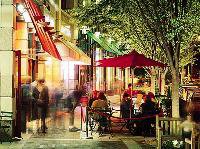 They call it creating a sense of place; a livable, walkable, workable community where residential, retail and recreational space come together, seamlessly, as brownfields give way to the new suburbia.
New Urbanism, or what we on Long Island may choose to call, New Suburbanism, is both a bold and innovative concept of recent vintage, and a mainstay of "downtown" and "Main Street" development that has its roots in the old world vision of European cities.
The Congress for New Urbanism (CNU), founded in 1993 by a group of entusiastic architects, "advocates the restructuring of public policy and development practices to support the restoration of existing urban centers and towns within coherent metropolitan regions, ...and the reconfiguration of sprawling suburbs into communities of real neighborhoods and diverse districts, the conservation of natural environments, and the preservation of our built legacy."
CNU, which has a presence in 20 countries and 49 states, promotes the creation and maintenance of what has come to be known as "sustainable communities."
"Sustainable communities?" Hmmm. We've heard that catch phrase before in these parts. Yet, go out and find us a true "sustainable community" on our Long Island, where, with rare exception, "smart growth" remains the consummate oxymoron.
The principles of the New Urbanism, as espoused by CNU and others of their visionary ilk, seek to combine, in appropriate scale, the following elements:
1. Walkability - Most things within a 10-minute walk of home and work-Pedestrian friendly street design (buildings close to street; porches, windows & doors; tree-lined streets; on street parking; hidden parking lots; garages in rear lane; narrow, slow speed streets) -Pedestrian streets free of cars in special cases;
2. Connectivity - Interconnected street grid network disperses traffic & eases walking-A hierarchy of narrow streets, boulevards, and alleys-High quality pedestrian network and public realm makes walking pleasurable;
3. Mixed-Use & Diversity - A mix of shops, offices, apartments, and homes on site. Mixed-use within neighborhoods, within blocks, and within buildings-Diversity of people - of ages, income levels, cultures, and races;
4. Mixed Housing - A range of types, sizes and prices in closer proximity;
5. Quality Architecture & Urban Design - Emphasis on beauty, aesthetics, human comfort, and creating a sense of place; Special placement of civic uses and sites within community. Human scale architecture & beautiful surroundings nourish the human spirit;
6. Traditional Neighborhood Structure - Discernable center and edge-Public space at center-Importance of quality public realm; public open space designed as civic art-Contains a range of uses and densities within 10-minute walk-Transect planning: Highest densities at town center; progressively less dense towards the edge. The transect is an analytical system that conceptualizes mutually reinforcing elements, creating a series of specific natural habitats and/or urban lifestyle settings. The Transect integrates environmental methodology for habitat assessment with zoning methodology for community design. The professional boundary between the natural and man-made disappears, enabling environmentalists to asses the design of the human habitat and the urbanists to support the viability of nature. This urban-to-rural transect hierarchy has appropriate building and street types for each area along the continuum;
7. Increased Density - More buildings, residences, shops, and services closer together for ease of walking, to enable a more efficient use of services and resources, and to create a more convenient, enjoyable place to live.-New Urbanism design principles are applied at the full range of densities from small towns, to large cities;
8. Smart Transportation - A network of high-quality trains connecting cities, towns, and neighborhoods together-Pedestrian-friendly design that encourages a greater use of bicycles, rollerblades, scooters, and walking as daily transportation;
9. Sustainability - Minimal environmental impact of development and its operations-Eco-friendly technologies, respect for ecology and value of natural systems-Energy efficiency-Less use of finite fuels-More local production-More walking, less driving;
10. Quality of Life - Taken together these add up to a high quality of life well worth living, and create places that enrich, uplift, and inspire the human spirit.
Now, how many of these qualities describe the community you live in? Not many, we presume.
Yes, the vision appears high-falutin, pie in the sky -- particularly for a region where "can do" too often takes a back seat to "wait and see" -- and yet, it has been and continues to be done, in both urban and suburban settings previously thought to be too far gone for revitalization.
Seaside, Florida, while a far cry from the shores of Freeport, New York, was the proving ground for the New Urbanism. Closer to home, although a decidedly more urban setting, Battery Park City found it's portal to renewal through the process of vision coupled with intelligent design.
You don't have to travel to Florida or trek into the city to see "downtown" revitalization at work. Click HERE to see just some of the accomplishments of the Oyster Bay Main Street Association.
Check out, too, I'ON, near Charleston, SC; Glenwood Park, at the edge of downtown Atlanta; Addison Circle in Dallas; and Pearl District in Portland, OR. New towns incorporating old ideas, revisited and recasted to fit our modern lifestyle. Each community facing its own special challenges.
Lest anyone think that one has to start anew -- building a new suburbia from the ground up -- remember Lincoln Road in what is now South Beach. A sprawling stretch of decay, decline and desolation is today considered one of the greatest pedestrian streets in America. Lined from one end to the other (nearly 10 blocks long) with cafes, international restaurants, fine shops, art galleries, cinemas, theaters, and entertainment set among beautiful fountains and lush tropical gardens.
"Oh, it will never happen here." Ah, the words of a true Long Island naysayer. Yes, it CAN happen here, IF we want it to happen here. It is up to us, as true advocates and activists, to MAKE IT HAPPEN!
And just what are the benefits of this New Urbanism? They are many and varied.
1. BENEFITS TO RESIDENTS: Higher quality of life; Better places to live, work, & play; Higher, more stable property values; Less traffic congestion & less driving; Healthier lifestyle with more walking, and less stress; Close proximity to main street retail & services; Close proximity to bike trails, parks, and nature; Pedestrian friendly communities offer more opportunities to get to know others in the neighborhood and town, resulting in meaningful relationships with more people, and a friendlier town; More freedom and independence to children, elderly, and the poor in being able to get to jobs, recreation, and services without the need for a car or someone to drive them; Great savings to residents and school boards in reduced busing costs from children being able to walk or bicycle to neighborhood schools; More diversity and smaller, unique shops and services with local owners who are involved in community; Big savings by driving less, and owning less cars; Less ugly, congested sprawl to deal with daily; Better sense of place and community identity with more unique architecture; More open space to enjoy that will remain open space; More efficient use of tax money with less spent on spread out utilities and roads;
2. BENEFITS TO BUSINESSES: Increased sales due to more foot traffic & people spending less on cars and gas; More profits due to spending less on advertising and large signs; Better lifestyle by living above shop in live-work units - saves the stressful & costly commute; Economies of scale in marketing due to close proximity and cooperation with other local businesses; Smaller spaces promote small local business incubation; Lower rents due to smaller spaces & smaller parking lots; Healthier lifestyle due to more walking and being near healthier restaurants; More community involvement from being part of community and knowing residents;
3. BENEFITS TO DEVELOPERS: More income potential from higher density mixed-use projects due to more leasable square footage, more sales per square foot, and higher property values and selling prices; Faster approvals in communities that have adopted smart growth principles resulting in cost/time savings; Cost savings in parking facilities in mixed-use properties due to sharing of spaces throughout the day and night, resulting in less duplication in providing parking; Less need for parking facilities due to mix of residences and commercial uses within walking distance of each other; Less impact on roads / traffic, which can result in lower impact fees; Lower cost of utilities due to compact nature of New Urbanist design; Greater acceptance by the public and less resistance from NIMBYS; Faster sell out due to greater acceptance by consumers from a wider product range resulting in wider market share;
4. BENEFITS TO MUNICIPALITIES: Stable, appreciating tax base; Less spent per capita on infrastructure and utilities than typical suburban development due to compact, high-density nature of projects; Increased tax base due to more buildings packed into a tighter area; Less traffic congestion due to walkability of design; Less crime and less spent on policing due to the presence of more people day and night; Less resistance from community; Better overall community image and sense of place; Less incentive to sprawl when urban core area is desirable; Easy to install transit where it's not, and improve it where it is; Greater civic involvement of population leads to better governance.
It would seem that we have much to consider and to think about as we envsion that new suburbia -- the rebirth of our business districts in a symbiotic marriage with a reinvigorated residential community. Mixed use, smart growth, the New Urbanism, and that old "can do" spirit that truly becomes community most.
A lot to think about, indeed. Even more, beyond the visioning process and away from the drafting table, to actually do. Yes, DO! And a word to the wise -- and the perpetually complacent -- that we best get to it, moving beyond the talk, the platitudes, the surveys, polls, and the Q & A sessions, lest another year in suburbia, and the real opportunity to reinvent it, pass us by!
- - -
Click HERE to download the SMART CODE.
Click HERE to learn more about New Urbanism and Smart Growth.
Click HERE for a look at Sustainable Long Island.
Click HERE to take that vision to the next level with Vision Long Island.
SEE ALSO, Whatever Happened To "Operation Downtown?"
- - -
Next on the "TO DO" list - Become an activist for the cause in your local civic association. Enlist your neighbors, friends, and local elected officials in the continuing struggle to take back our town!
- - -
By the way, we'd love to hear your thoughts, comments and ideas. A Guest Blog, anyone? Planners, suburban designers, and friends of smart growth and sustainable communities are particularly welcome to put it here, in our sustainable online community! Write us at info@thecommunityalliance.org.
- - -
COMING UP: You Can Get There From Here!
Tuesday, April 15, 2008
D-Day For Special Districts
Findings And Recommendations of Commission On Local Government Efficiency Due Today
Its not just tax day, fellow Americans. This is the day -- April 15 -- when, pursuant to Executive Order of former Governor Eliot Spitzer, the NYS Commission On Local Government Efficiency & Competitiveness (yes, we know. It remains an oxymoron) is to render its final report and issue full recommendations on what to do about New York's more than 4200 special taxing districts.
The Community Alliance will publish the Commission's report, in its entirety, as soon as it is made available, right here on this blog.
Whatever the Commission's recommendations, don't expect overnight change or swift action on the part of the NYS Legislature.
After all, not a single one of the Commission's preliminary recommendations, as presented to the Legislature by way of incorporation into this year's proposed budget, made it to the final budget placed on Governor Paterson's desk for signature. [Click HERE for the Herald Community Newspapers' article, STATE BUDGET: No Action On Special Districts.]
Read through the Commission's mandate, republished below, and then, stay tuned...
Oh, and by the way, you have until 11:59 PM to postmark your tax returns!
- - -
No. 11
E X E C U T I V E O R D E R
ESTABLISHING THE NEW YORK STATE COMMISSION ON LOCAL GOVERNMENT EFFICIENCY AND COMPETITIVENESS
WHEREAS, New York’s local governments are established and operate under New York’s Constitution, statutes and regulations and receive financial and governance support from the State; and
WHEREAS, local governments, including counties, towns, cities, villages and special purpose districts, such as school and fire districts, provide many of the public services which determine whether New York’s residents and businesses live and conduct commerce safely, healthily, productively and happily; and
WHEREAS, New York’s local governments, including more than 4200 taxing jurisdictions, have evolved over centuries, and in many cases reflect circumstances, population concentrations and needs which have changed significantly or no longer exist; and
WHEREAS, the sheer number of such taxing jurisdictions and their overlapping and multi-layered nature cause public services to be excessively expensive, and provided in a manner that is inefficient and reduces the competitiveness of New York’s localities and the job and business opportunities for New Yorkers; and
WHEREAS, many New Yorkers are unaware of the boundaries and very existence of many taxing jurisdictions and special districts, and this results in an extraordinarily low level of participation in many local government elections; and
WHEREAS, the opportunities for smart growth and regionalization of the delivery of certain public services such as public transportation, waste management, information technology and water supply are often inhibited by New York’s fragmented local government structure; and
WHEREAS, New York’s local tax burden is the highest in the United States and negatively impacts competitiveness and the quality of life; and
WHEREAS, New York’s laws, regulations and programs have been only minimally effective in assisting local governments to partner in the efficient delivery of public services, to merge, consolidate or regionalize local government, to adopt smart growth practices, and otherwise improve the living environment for New Yorkers; and 2
WHEREAS, a comprehensive analysis is needed:
(1) to identify the barriers which inhibit more efficient local government, the merger, consolidation or regionalization of local government, partnering among local governments to more efficiently provide public services, adoption of smart growth practices, and the procurement and construction of regional transportation and other infrastructure which improves the efficiency, competitiveness and quality of life of New York’s localities; and
(2) to guide the formulation and development of tools to assist local governments to pursue and achieve these objectives;
NOW THERFORE, I, Eliot Spitzer, Governor of the State Of New York, by virtue of the authority vested in me by the Constitution and Laws of the State of New York do hereby order as follows:
1. There is hereby established the New York State Commission on Local Government Efficiency and Competitiveness ("Commission").
2. The Commission shall consist of fifteen members appointed by the Governor, including one member appointed upon the recommendation of the Comptroller, one upon the recommendation of the Speaker of the Assembly, one upon the recommendation of the Majority Leader of the Senate, one upon the recommendation of the Minority Leader of the Assembly, one upon the recommendation of the Minority Leader of the Senate, at least one individual representing a member of the New York State Association of Counties, at least one individual representing a member of the New York State Association of Towns, and at least one individual representing a member of the New York Conference of Mayors and Municipal Officials.
3. The Governor shall select a chair of the Commission from among the members. A majority of the members of the Commission shall constitute a quorum, and all recommendations of the Commission shall require approval of a majority of the total members of the Commission.
4. The Governor shall appoint an Executive Director of the Commission, who shall be an employee of one of the executive branch agencies herein directed by the Governor to render assistance to the Commission.
5. The Commission shall conduct a review and analysis of New York’s local government structure and operations, and to the maximum extent possible shall consider, and where appropriate incorporate, the expertise and learning of prior commissions, studies and academic institutions engaged in local government studies, and state agencies with responsibility for assisting local government, including but not limited to the Department of State, the Office of Real Property Services, the Urban Development Corporation, the Department of Economic Development, the Division of the Budget, the Governor’s Office of Regulatory Reform, the Office of State Comptroller and the State Education Department.
6. The Commission shall make recommendations on ways to consolidate and eliminate taxing jurisdictions, special districts, and other local government entities where doing so would improve the effectiveness and efficiency of local government. 3
7. The Commission’s review shall include an analysis of:
(a) the number and types of local government jurisdictions in New York State, the basis for their creation, and the opportunities and barriers to their restructuring, merger, consolidation or partnership to deliver public services;
(b) the nature and extent of services delivered by various types of local governments;
(c) the services which lend themselves most logically, efficiently and easily to merger, consolidation or partnership initiatives;
(d) opportunities and barriers to the regionalization of local government functions and services and the extent to which "smart growth" practices can improve the performance of local government and the delivery of public services and enhance New York’s competitiveness;
(e) the procedures for and effectiveness of local government elections, including the percentage of eligible and registered voters who participate in such elections, and the utilization of common election dates and procedures by local governments which serve a substantially common electorate;
(f) the degree to which local government electorates are presented periodically with the option of dissolving the local government or reaffirming the local government’s continuation; and
(g) the effectiveness of existing state laws and programs designed to assist local government efficiency, consolidation, merger, partnership in government operations and service delivery, smart growth, and the procurement and construction of regional transportation and other instrumentalities and infrastructure.
8. In undertaking this review and analysis the Commission may request documents, conduct public hearings, take the testimony of witnesses in the form and manner which it deems most efficient, and take all other actions necessary to carry out its functions.
9. The Commission shall make recommendations which it deems necessary or advisable for:
(a) strengthening and streamlining the structure and operations of local governments;
(b) reducing the costs of and improving the effectiveness of local government operations and services;
(c) facilitating the merger, consolidation and partnering in the delivery of services by and between local governments;
(d) promoting and facilitating regional government and the regionalized delivery of public services; and
(e) reforming election laws and procedures to increase and maximize the awareness of local governments among the electorate and maximize participation in local government elections and proceedings.
10. The Commission shall issue a report of its findings and recommendations on or before April 15, 2008. The report shall be submitted to the Governor, the Comptroller, the Majority Leader of the Senate, the Speaker of the Assembly, the Minority Leader of the Senate, and the Minority Leader of the Assembly.
11. No member of the Commission shall be disqualified from holding any public office or employment, nor shall he or she forfeit any such office or employment by virtue of his or her appointment hereunder. Members of the Commission shall receive no compensation for their services but shall be allowed their actual and necessary expenses incurred in the performance of their functions hereunder. All members of the Commission shall serve at the pleasure of the Governor and vacancies shall be filled in the same manner as original appointments.
12. Every agency department, office, division or public authority of this state shall cooperate with the Commission and furnish such information and assistance as the Commission determines is reasonably necessary to accomplish its purpose.
GIVEN under my hand and the Privy Seal
of the State this ____________ day of
April in the year two thousand seven.
BY THE GOVERNOR
Secretary to the Governor
Its not just tax day, fellow Americans. This is the day -- April 15 -- when, pursuant to Executive Order of former Governor Eliot Spitzer, the NYS Commission On Local Government Efficiency & Competitiveness (yes, we know. It remains an oxymoron) is to render its final report and issue full recommendations on what to do about New York's more than 4200 special taxing districts.
The Community Alliance will publish the Commission's report, in its entirety, as soon as it is made available, right here on this blog.
Whatever the Commission's recommendations, don't expect overnight change or swift action on the part of the NYS Legislature.
After all, not a single one of the Commission's preliminary recommendations, as presented to the Legislature by way of incorporation into this year's proposed budget, made it to the final budget placed on Governor Paterson's desk for signature. [Click HERE for the Herald Community Newspapers' article, STATE BUDGET: No Action On Special Districts.]
Read through the Commission's mandate, republished below, and then, stay tuned...
Oh, and by the way, you have until 11:59 PM to postmark your tax returns!
- - -
No. 11
E X E C U T I V E O R D E R
ESTABLISHING THE NEW YORK STATE COMMISSION ON LOCAL GOVERNMENT EFFICIENCY AND COMPETITIVENESS
WHEREAS, New York’s local governments are established and operate under New York’s Constitution, statutes and regulations and receive financial and governance support from the State; and
WHEREAS, local governments, including counties, towns, cities, villages and special purpose districts, such as school and fire districts, provide many of the public services which determine whether New York’s residents and businesses live and conduct commerce safely, healthily, productively and happily; and
WHEREAS, New York’s local governments, including more than 4200 taxing jurisdictions, have evolved over centuries, and in many cases reflect circumstances, population concentrations and needs which have changed significantly or no longer exist; and
WHEREAS, the sheer number of such taxing jurisdictions and their overlapping and multi-layered nature cause public services to be excessively expensive, and provided in a manner that is inefficient and reduces the competitiveness of New York’s localities and the job and business opportunities for New Yorkers; and
WHEREAS, many New Yorkers are unaware of the boundaries and very existence of many taxing jurisdictions and special districts, and this results in an extraordinarily low level of participation in many local government elections; and
WHEREAS, the opportunities for smart growth and regionalization of the delivery of certain public services such as public transportation, waste management, information technology and water supply are often inhibited by New York’s fragmented local government structure; and
WHEREAS, New York’s local tax burden is the highest in the United States and negatively impacts competitiveness and the quality of life; and
WHEREAS, New York’s laws, regulations and programs have been only minimally effective in assisting local governments to partner in the efficient delivery of public services, to merge, consolidate or regionalize local government, to adopt smart growth practices, and otherwise improve the living environment for New Yorkers; and 2
WHEREAS, a comprehensive analysis is needed:
(1) to identify the barriers which inhibit more efficient local government, the merger, consolidation or regionalization of local government, partnering among local governments to more efficiently provide public services, adoption of smart growth practices, and the procurement and construction of regional transportation and other infrastructure which improves the efficiency, competitiveness and quality of life of New York’s localities; and
(2) to guide the formulation and development of tools to assist local governments to pursue and achieve these objectives;
NOW THERFORE, I, Eliot Spitzer, Governor of the State Of New York, by virtue of the authority vested in me by the Constitution and Laws of the State of New York do hereby order as follows:
1. There is hereby established the New York State Commission on Local Government Efficiency and Competitiveness ("Commission").
2. The Commission shall consist of fifteen members appointed by the Governor, including one member appointed upon the recommendation of the Comptroller, one upon the recommendation of the Speaker of the Assembly, one upon the recommendation of the Majority Leader of the Senate, one upon the recommendation of the Minority Leader of the Assembly, one upon the recommendation of the Minority Leader of the Senate, at least one individual representing a member of the New York State Association of Counties, at least one individual representing a member of the New York State Association of Towns, and at least one individual representing a member of the New York Conference of Mayors and Municipal Officials.
3. The Governor shall select a chair of the Commission from among the members. A majority of the members of the Commission shall constitute a quorum, and all recommendations of the Commission shall require approval of a majority of the total members of the Commission.
4. The Governor shall appoint an Executive Director of the Commission, who shall be an employee of one of the executive branch agencies herein directed by the Governor to render assistance to the Commission.
5. The Commission shall conduct a review and analysis of New York’s local government structure and operations, and to the maximum extent possible shall consider, and where appropriate incorporate, the expertise and learning of prior commissions, studies and academic institutions engaged in local government studies, and state agencies with responsibility for assisting local government, including but not limited to the Department of State, the Office of Real Property Services, the Urban Development Corporation, the Department of Economic Development, the Division of the Budget, the Governor’s Office of Regulatory Reform, the Office of State Comptroller and the State Education Department.
6. The Commission shall make recommendations on ways to consolidate and eliminate taxing jurisdictions, special districts, and other local government entities where doing so would improve the effectiveness and efficiency of local government. 3
7. The Commission’s review shall include an analysis of:
(a) the number and types of local government jurisdictions in New York State, the basis for their creation, and the opportunities and barriers to their restructuring, merger, consolidation or partnership to deliver public services;
(b) the nature and extent of services delivered by various types of local governments;
(c) the services which lend themselves most logically, efficiently and easily to merger, consolidation or partnership initiatives;
(d) opportunities and barriers to the regionalization of local government functions and services and the extent to which "smart growth" practices can improve the performance of local government and the delivery of public services and enhance New York’s competitiveness;
(e) the procedures for and effectiveness of local government elections, including the percentage of eligible and registered voters who participate in such elections, and the utilization of common election dates and procedures by local governments which serve a substantially common electorate;
(f) the degree to which local government electorates are presented periodically with the option of dissolving the local government or reaffirming the local government’s continuation; and
(g) the effectiveness of existing state laws and programs designed to assist local government efficiency, consolidation, merger, partnership in government operations and service delivery, smart growth, and the procurement and construction of regional transportation and other instrumentalities and infrastructure.
8. In undertaking this review and analysis the Commission may request documents, conduct public hearings, take the testimony of witnesses in the form and manner which it deems most efficient, and take all other actions necessary to carry out its functions.
9. The Commission shall make recommendations which it deems necessary or advisable for:
(a) strengthening and streamlining the structure and operations of local governments;
(b) reducing the costs of and improving the effectiveness of local government operations and services;
(c) facilitating the merger, consolidation and partnering in the delivery of services by and between local governments;
(d) promoting and facilitating regional government and the regionalized delivery of public services; and
(e) reforming election laws and procedures to increase and maximize the awareness of local governments among the electorate and maximize participation in local government elections and proceedings.
10. The Commission shall issue a report of its findings and recommendations on or before April 15, 2008. The report shall be submitted to the Governor, the Comptroller, the Majority Leader of the Senate, the Speaker of the Assembly, the Minority Leader of the Senate, and the Minority Leader of the Assembly.
11. No member of the Commission shall be disqualified from holding any public office or employment, nor shall he or she forfeit any such office or employment by virtue of his or her appointment hereunder. Members of the Commission shall receive no compensation for their services but shall be allowed their actual and necessary expenses incurred in the performance of their functions hereunder. All members of the Commission shall serve at the pleasure of the Governor and vacancies shall be filled in the same manner as original appointments.
12. Every agency department, office, division or public authority of this state shall cooperate with the Commission and furnish such information and assistance as the Commission determines is reasonably necessary to accomplish its purpose.
GIVEN under my hand and the Privy Seal
of the State this ____________ day of
April in the year two thousand seven.
BY THE GOVERNOR
Secretary to the Governor
Subscribe to:
Posts (Atom)